
Exam: 200-301

|
|||||||||||||||||||||||||||

Certkingdom's provide the best learning material includes the maximum exquisite features, prepared with the aid of the identical dedicated specialists who have come collectively to provide an incorporated solution. We provide the maximum outstanding and simple approach to bypass your certification exams on the first strive "assured"
This exam tests your knowledge and skills related to:
Network fundamentals
Network access
IP connectivity
IP services
Security fundamentals
Automation and programmability
Exam preparation
Official Cisco training
Implementing and Administering Cisco Solutions (CCNA)
CCNA training videos
CCNA study materials
CCNA Exam v1.0 (200-301)
Exam Description: CCNA Exam v1.0 (CCNA 200-301) is a 120-minute exam
associated with the CCNA certification. This exam tests a candidate's knowledge
and skills related to network fundamentals, network access, IP connectivity, IP
services, security fundamentals, and automation and programmability. The course,
Implementing and Administering Cisco Solutions (CCNA), helps candidates prepare
for this exam.
The following topics are general guidelines for the content likely to be
included on the exam. However, other related topics may also appear on any
specific delivery of the exam. To better reflect the contents of the exam and
for clarity purposes, the guidelines below may change at any time without
notice.
20% 1.0 Network Fundamentals
1.1 Explain the role and function of network components
1.1.a Routers
1.1.b Layer 2 and Layer 3 switches
1.1.c Next-generation firewalls and IPS
1.1.d Access points
1.1.e Controllers (Cisco DNA Center and WLC)
1.1.f Endpoints
1.1.g Servers
1.1.h PoE
1.2 Describe characteristics of network topology architectures
1.2.a Two-tier
1.2.b Three-tier
1.2.c Spine-leaf
1.2.d WAN
1.2.e Small office/home office (SOHO)
1.2.f On-premise and cloud
1.3 Compare physical interface and cabling types
1.3.a Single-mode fiber, multimode fiber, copper
1.3.b Connections (Ethernet shared media and point-to-point)
1.4 Identify interface and cable issues (collisions, errors, mismatch duplex,
and/or speed)
1.5 Compare TCP to UDP
1.6 Configure and verify IPv4 addressing and subnetting
1.7 Describe the need for private IPv4 addressing
1.8 Configure and verify IPv6 addressing and prefix
1.9 Describe IPv6 address types
1.9.a Unicast (global, unique local, and link local)
1.9.b Anycast
1.9.c Multicast
1.9.d Modified EUI 64
1.10 Verify IP parameters for Client OS (Windows, Mac OS, Linux)
1.11 Describe wireless principles
1.11.a Nonoverlapping Wi-Fi channels
1.11.b SSID
1.11.c RF
1.11.d Encryption
1.12 Explain virtualization fundamentals (server virtualization, containers, and
VRFs)
1.13 Describe switching concepts
1.13.a MAC learning and aging
1.13.b Frame switching
1.13.c Frame flooding
1.13.d MAC address table
20% 2.0 Network Access
2.1 Configure and verify VLANs (normal range) spanning multiple switches
2.1.a Access ports (data and voice)
2.1.b Default VLAN
2.1.c InterVLAN connectivity
2.2 Configure and verify interswitch connectivity
2.2.a Trunk ports
2.2.b 802.1Q
2.2.c Native VLAN
2.3 Configure and verify Layer 2 discovery protocols (Cisco Discovery Protocol
and LLDP)
2.4 Configure and verify (Layer 2/Layer 3) EtherChannel (LACP)
2.5 Interpret basic operations of Rapid PVST+ Spanning Tree Protocol
2.5.a Root port, root bridge (primary/secondary), and other port names
2.5.b Port states (forwarding/blocking)
2.5.c PortFast
2.6 Describe Cisco Wireless Architectures and AP modes
2.7 Describe physical infrastructure connections of WLAN components (AP, WLC,
access/trunk ports, and LAG)
2.8 Describe AP and WLC management access connections (Telnet, SSH, HTTP, HTTPS,
console, and TACACS+/RADIUS)
2.9 Interpret the wireless LAN GUI configuration for client connectivity, such
as WLAN creation, security settings, QoS profiles, and advanced settings
25% 3.0 IP Connectivity
3.1 Interpret the components of routing table
3.1.a Routing protocol code
3.1.b Prefix
3.1.c Network mask
3.1.d Next hop
3.1.e Administrative distance
3.1.f Metric
3.1.g Gateway of last resort
3.2 Determine how a router makes a forwarding decision by default
3.2.a Longest prefix match
3.2.b Administrative distance
3.2.c Routing protocol metric
3.3 Configure and verify IPv4 and IPv6 static routing
3.3.a Default route
3.3.b Network route
3.3.c Host route
3.3.d Floating static
3.4 Configure and verify single area OSPFv2
3.4.a Neighbor adjacencies
3.4.b Point-to-point
3.4.c Broadcast (DR/BDR selection)
3.4.d Router ID
3.5 Describe the purpose, functions, and concepts of first hop redundancy
protocols
10% 4.0 IP Services
4.1 Configure and verify inside source NAT using static and pools
4.2 Configure and verify NTP operating in a client and server mode
4.3 Explain the role of DHCP and DNS within the network
4.4 Explain the function of SNMP in network operations
4.5 Describe the use of syslog features including facilities and levels
4.6 Configure and verify DHCP client and relay
4.7 Explain the forwarding per-hop behavior (PHB) for QoS, such as
classification, marking, queuing, congestion, policing, and shaping
4.8 Configure network devices for remote access using SSH
4.9 Describe the capabilities and functions of TFTP/FTP in the network
15% 5.0 Security Fundamentals
5.1 Define key security concepts (threats, vulnerabilities, exploits, and
mitigation techniques)
5.2 Describe security program elements (user awareness, training, and physical
access control)
5.3 Configure and verify device access control using local passwords
5.4 Describe security password policies elements, such as management,
complexity, and password alternatives (multifactor authentication, certificates,
and biometrics)
5.5 Describe IPsec remote access and site-to-site VPNs
5.6 Configure and verify access control lists
5.7 Configure and verify Layer 2 security features (DHCP snooping, dynamic ARP
inspection, and port security)
5.8 Compare authentication, authorization, and accounting concepts
5.9 Describe wireless security protocols (WPA, WPA2, and WPA3)
5.10 Configure and verify WLAN within the GUI using WPA2 PSK
10% 6.0 Automation and Programmability
6.1 Explain how automation impacts network management
6.2 Compare traditional networks with controller-based networking
6.3 Describe controller-based, software defined architecture (overlay, underlay,
and fabric)
6.3.a Separation of control plane and data plane
6.3.b Northbound and Southbound APIs
6.4 Compare traditional campus device management with Cisco DNA Center enabled
device management
6.5 Describe characteristics of REST-based APIs (CRUD, HTTP verbs, and data
encoding)
6.6 Recognize the capabilities of configuration management mechanisms Puppet,
Chef, and Ansible
6.7 Recognize components of JSON-encoded data
200-301 Brain Dumps Exam + Online / Offline and Android Testing Engine & 4500+ other exams included
$50 - $25 (you save $25)
Buy Now
QUESTION 1
Refer to the exhibit. Which type of route does R1 use to reach host
10.10.13.10/32?
A. default route
B. network route
C. host route
D. floating static route
Answer: B
QUESTION 2
Refer to the exhibit. Which prefix does Router1 use for traffic to Host A?
A. 10.10.10.0/28
B. 10.10.13.0/25
C. 10.10.13.144/28
D. 10.10.13.208/29
Answer: D
QUESTION 4
A frame that enters a switch fails the Frame Check Sequence. Which two
interface counters are incremented?
(Choose two.)
A. input errors
B. frame
C. giants
D. CRC
E. runts
Answer: A,D
QUESTION 5
How do TCP and UDP differ in the way that they establish a connection
between two endpoints?
A. TCP uses the three-way handshake, and UDP does not guarantee message
delivery.
B. TCP uses synchronization packets, and UDP uses acknowledgment packets.
C. UDP provides reliable message transfer, and TCP is a connectionless protocol.
D. UDP uses SYN, SYN ACK, and FIN bits in the frame header while TCP uses SYN,
SYN ACK, and ACK bits.
Answer: A
QUESTION 6
Which 802.11 frame type is Association Response?
A. management
B. protected frame
C. action
D. control
Answer: A
QUESTION 7
In which way does a spine-and-leaf architecture allow for scalability in a
network when additional access ports are required?
A. A spine switch and a leaf switch can be added with redundant connections
between them.
B. A spine switch can be added with at least 40 GB uplinks.
C. A leaf switch can be added with connections to every spine switch.
D. A leaf switch can be added with a single connection to a core spine switch.
Answer: C
QUESTION 8
What identifies the functionality of virtual machines?
A. The hypervisor communicates on Layer 3 without the need for additional
resources.
B. Each hypervisor supports a single virtual machine and a single software
switch.
C. The hypervisor virtualizes physical components including CPU, memory, and
storage.
D. Virtualized servers run efficiently when physically connected to a switch
that is separate from the hypervisor.
Answer: C
QUESTION 9
Which command automatically generates an IPv6 address from a specified IPv6
prefix and MAC address of an interface?
A. ipv6 address dhcp
B. ipv6 address 2001:DB8:5:112::/64 eui-64
C. ipv6 address autoconfig
D. ipv6 address 2001:DB8:5:112::2/64 link-local
Answer: C
QUESTION 10
When configuring IPv6 on an interface, which two IPv6 multicast groups are
joined? (Choose two.)
A. 2000::/3
B. 2002::5
C. FC00::/7
D. FF02::1
E. FF02::2
Answer: D,E
Buy Complete
These are real testimonials.
"I passed the 200-301 exam thanks to the study materials and practice tests provided by Certkingdom. These resources were very helpful in preparing me for the exam and I highly recommend them to anyone who wants to validate their knowledge of HPE Ezmeral Runtime Enterprise solutions."
"I have been a customer of Certkingdom.com for several months and I am extremely satisfied with the quality of the study materials and support provided. The materials were easy to understand and covered everything I needed to know for the 200-301 exam. I couldn't have passed the exam without the help of Certkingdom."
"I have been working in container orchestration for several years and I find Certkingdom to be an invaluable resource for staying current on industry trends and best practices. The 200-301 exam was no exception, and I passed it with flying colors thanks to the comprehensive study materials and practice tests provided by Certkingdom.."
"As an HPE Student, I was required to pass the 200-301 exam to continue working with their solutions. I found Certkingdom to be an excellent resource for preparing for the exam. The study materials were detailed and up-to-date and the practice tests helped me gauge my progress and identify areas where I needed to focus more.."
"I found Certkingdom to be a great resource for preparing for the 200-301 exam. The study materials were well-organized and easy to follow. The practice tests were also very helpful and helped me identify my weaknesses and focus on the areas where I needed improvement. I passed the exam on my first try and couldn't have done it without the help of Certkingdom.com. Thank you Certkingdom."
Certkingdom Offline Testing Engine Simulator Download

Prepare with yourself how CertKingdom Offline Exam Simulator it is designed specifically for any exam preparation. It allows you to create, edit, and take practice tests in an environment very similar to an actual exam.
Supported Platforms: Windows-7 64bit or later - EULA | How to Install?
FAQ's: Windows-8 / Windows 10 if you face any issue kinldy uninstall and reinstall the Simulator again.
Download Offline Simulator-Beta
Certkingdom Testing Engine Features
- Certkingdom Testing Engine simulates the real exam environment.
- Interactive Testing Engine Included
- Live Web App Testing Engine
- Offline Downloadable Desktop App Testing Engine
- Testing Engine App for Android
- Testing Engine App for iPhone
- Testing Engine App for iPad
- Working with the Certkingdom Testing Engine is just like taking the real tests, except we also give you the correct answers.
- More importantly, we also give you detailed explanations to ensure you fully understand how and why the answers are correct.
Certkingdom Android Testing Engine Simulator Download
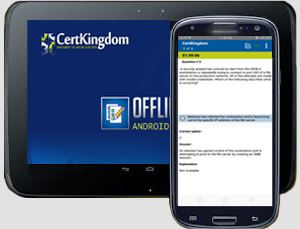
Take your learning mobile android device with all the features as desktop offline testing engine. All android devices are supported.
Supported Platforms: All Android OS EULA
Install the Android Testing Engine from google play store and download the app.ck from certkingdom website android testing engine download

Certkingdom Android Testing Engine Features
- CertKingdom Offline Android Testing Engine
- Make sure to enable Root check in Playstore
- Live Realistic practice tests
- Live Virtual test environment
- Live Practice test environment
- Mark unanswered Q&A
- Free Updates
- Save your tests results
- Re-examine the unanswered Q & A
- Make your own test scenario (settings)
- Just like the real tests: multiple choice questions
- Updated regularly, always current
