
Exam: Salesforce-MuleSoft-Associate
|
|||||||||||||||||||||||||||

Description
About the Salesforce Certified MuleSoft Integration Foundations
The Salesforce Certified MuleSoft Integration Foundations Exam is designed for
individuals interested in working as part of a MuleSoft project team. It
validates foundational knowledge of integration concepts, API-led connectivity,
and core MuleSoft terminology.
Audience Overview
This certification is ideal for professionals who want to understand:
The roles, responsibilities, and lifecycle phases of typical integration
projects
Key integration concepts and terminology used by MuleSoft architects and
developers
Common integration challenges, fundamental use cases, and technologies to
address them
Technical complexities central to integration development
The components and advantages of the MuleSoft Anypoint Platform for system
integration and API management
Typical job roles for certified candidates include:
Developers
Architects
Project Managers & Technical Project Managers
Integration Product Owners
IT Professionals and IT Operations Teams
Exam Details
Format: 40 multiple-choice questions + up to 5 unscored questions
Time: 70 minutes
Passing Score: 70%
Exam Version: Spring ’24 Release
Registration Fee: USD $75 (plus applicable taxes)
Retake Fee: Free
Delivery Options: Proctored exam (online or onsite) – [View scheduling details]
Reference Materials: No external resources allowed during the exam
Prerequisites: None required
Exam Outline
The Salesforce Certified MuleSoft Integration Foundations Exam measures a
candidate’s knowledge and skills related to the following objectives. Candidates
should have an interest in working as an informed member of a MuleSoft project
team. MuleSoft Integration Foundations candidates should have knowledge of core
integration and application programming interface (API)-led connectivity
terminology and concepts, as well as the components and benefits of Anypoint
Platform for system integration and API management.
Identify the roles, responsibilities, and lifecycle of a integration project:
17%
Identify the common reasons that IT integration projects frequently fail.
Define the IT delivery gap and describe MuleSoft's approach to closing it.
Describe the characteristics and roles of an API-led IT delivery model that
emphasizes both production and consumption.
Describe the common delivery methodologies for integration projects.
Identify key DevOps practices and tools for building, testing, deploying, and
delivering integration solutions.
Identify and describe the steps of the design, implement, and management stages
of MuleSoft's recommended product-centric API lifecycle.
Describe the roles and responsibilities within a typical MuleSoft integration
project team.
Recognize and interpret essential integration concepts and terminology: 20%
Distinguish between Infrastructure as a Service (IaaS), Platform as a
Service (PaaS), and Software as a Service (SaaS).
Identify the types of virtualization, computing, and storage infrastructure
required by enterprise systems and describe the principles of system
scalability.
Classify and describe common networking protocols used in system communication.
Recognize the differences between common data formats (for example, XML, YAML,
and JSON) used in transformations and configuration files.
Define and describe the core concepts of API and enterprise system security.
Identify and describe the HTTP components that enable RESTful web services.
Define and correctly use the terms API implementation, API proxy, API interface,
API client/consumer, and API invocation.
Identify and classify RESTful, SOAP, AsyncAPI, and GraphQL APIs.
Recognize common integration problems, use cases, and technical solutions:
17%
Classify and describe the characteristics of common enterprise systems.
Classify and describe the tradeoffs of legacy and modern integration approaches.
Given a complex business problem, identify the fundamental integration use cases
that can deliver an end-to-end business solution.
Describe the purpose and function of the different classes of integration
technologies.
Identify the types of integration technologies that are most suitable to realize
different integration use cases and business scenarios.
Deconstruct an integration solution into its integration system constituents.
Explain the common technical complexities and patterns in integration
development: 18%
Describe the differences between the request-reply, one-way, multicast,
batch, and stream interaction patterns.
Explain the differences between the aggregation, orchestration, and choreography
composition patterns.
Describe the purpose of an API specification and the benefits of following a
design-first approach to API development.
Describe and compare observability approaches for integration solutions
including logs, metrics, and tracing.
Design MuleSoft applications using common features of core connectors.
Describe the differences between cloud, hybrid, and on-premise deployment
architectures.
Describe the differences and tradeoffs between monolithic and microservices
application architectures.
Describe the difference between a service mesh and an API gateway.
Describe the components and benefits of Anypoint Platform for system
integration: 18%
Identify the primary components of Anypoint Platform and their benefits for
system integration.
Identify and describe the common characteristics of popular Anypoint Connectors
for connecting to software applications, databases, and protocols.
Identify the components and describe the benefits of the Anypoint Platform
runtime planes and control planes.
Describe the MuleSoft-hosted and customer-hosted deployment options for Anypoint
Platform.
Describe the uses and benefits of the Anypoint Platform development tools and
languages for integration developers and DevOps teams.
Describe and classify the types of reusable assets in Anypoint Exchange that
form the building blocks of integration solutions.
Describe the components and benefits of Anypoint Platform for API management:
10%
Identify the primary components of Anypoint Platform and their benefits for
API management.
Identify how MuleSoft products realize the goals of full lifecycle API
development and Universal API Management (UAPIM).
Explain the advantages of API-led connectivity with Anypoint Platform over other
integration and API management approaches.
Salesforce-MuleSoft-Associate Brain Dumps Exam + Online / Offline and Android Testing Engine & 4500+ other exams included
$50 - $25 (you save $25)
Buy Now
QUESTION 1
A marketing associate needs to create a criteria-based subset of an audience
from another data extension without using structured query language (SQL).
Which data extension should the associate use?
A. Filtered Data Extension
B. Random Data Extension
C. Standard Data Extension
Answer: A
QUESTION 2
Northern Trail Outfitters created a new team to oversee its marketing
strategy. They want a way to
categorize content by any criteria, marketing tactic, geography, and product
line.
What should an associate recommend?
A. Enable content tags.
B. Create custom folder permissions.
C. Organize folders alphabetically.
Answer: A
QUESTION 3
A marketing associate needs to import a CSV file into a data extension.
Which delimiter should the associate select to correctly import this file type?
A. Tab
B. Pipe
C. Comma
Answer: C
QUESTION 4
A customer complains to Cloud Kicks (CK) that they missed the seasonal sale
email alerts.
The customer is unsure if they unsubscribed themselves but has not received any
emails from CK in the past 6 months.
Where should an associate view the status of the subscriber?
A. Synchronized Data Extensions in Contact Builder
B. All Subscribers in Email Studio
C. All Contacts in Contact Builder
Answer: B
QUESTION 5
According to GDPR principles, what is a company allowed to do after
collecting personal data from a client?
A. Retain client information after the client requests termination of the
relationship.
B. Contact the client in order to keep their personal data up to date.
C. Sell the information to other companies for marketing purposes.
Answer: B
Buy Complete
Students Feedback / Reviews/ Discussion
Mahrous Mostafa Adel Amin 1 week, 2 days ago - Abuhib- United Arab
Emirates
Passed the exam today, Got 98 questions in total, and 2 of them weren’t from
exam topics. Rest of them was exactly the same!
upvoted 4 times
Mbongiseni Dlongolo - South Africa2 weeks, 5 days ago
Thank you so much, I passed Salesforce-MuleSoft-Associate today! 41 questions out of 44 are from
Certkingdom
upvoted 2 times
Kenyon Stefanie 1 month, 1 week ago - USA State / Province = Virginia
Thank you so much, huge help! I passed Salesforce-MuleSoft-Associate Salesforce today! The big majority
of questions were from here.
upvoted 2 times
Danny 1 month, 1 week ago - United States CUSTOMER_STATE_NAME: Costa Mesa =
USA
Passed the exam today, 100% points. Got 44 questions in total, and 3 of them
weren’t from exam topics. Rest of them was exactly the same!
MENESES RAUL 93% 2 week ago - USA = Texas
was from this topic! I did buy the contributor access. Thank you certkingdom!
upvoted 4 times
Zemljaric Rok 1 month, 2 weeks ago - Ljubljana Slovenia
Cleared my exam today - Over 80% questions from here, many thanks certkingdom
and everyone for the meaningful discussions.
upvoted 2 times
logged members Can Post comments / review and take part in Discussion
Certkingdom Offline Testing Engine Simulator Download

Prepare with yourself how CertKingdom Offline Exam Simulator it is designed specifically for any exam preparation. It allows you to create, edit, and take practice tests in an environment very similar to an actual exam.
Supported Platforms: Windows-7 64bit or later - EULA | How to Install?
FAQ's: Windows-8 / Windows 10 if you face any issue kinldy uninstall and reinstall the Simulator again.
Download Offline Simulator-Beta
Certkingdom Testing Engine Features
- Certkingdom Testing Engine simulates the real exam environment.
- Interactive Testing Engine Included
- Live Web App Testing Engine
- Offline Downloadable Desktop App Testing Engine
- Testing Engine App for Android
- Testing Engine App for iPhone
- Testing Engine App for iPad
- Working with the Certkingdom Testing Engine is just like taking the real tests, except we also give you the correct answers.
- More importantly, we also give you detailed explanations to ensure you fully understand how and why the answers are correct.
Certkingdom Android Testing Engine Simulator Download
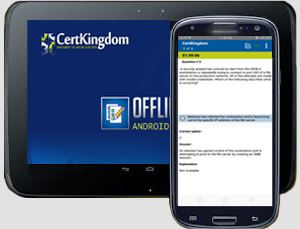
Take your learning mobile android device with all the features as desktop offline testing engine. All android devices are supported.
Supported Platforms: All Android OS EULA
Install the Android Testing Engine from google play store and download the app.ck from certkingdom website android testing engine download

Certkingdom Android Testing Engine Features
- CertKingdom Offline Android Testing Engine
- Make sure to enable Root check in Playstore
- Live Realistic practice tests
- Live Virtual test environment
- Live Practice test environment
- Mark unanswered Q&A
- Free Updates
- Save your tests results
- Re-examine the unanswered Q & A
- Make your own test scenario (settings)
- Just like the real tests: multiple choice questions
- Updated regularly, always current
