
Exam: Rev-Con-201
|
|||||||||||||||||||||||||||

Certified Revenue Cloud Consultants have hands-on experience designing and
implementing the Revenue Cloud product on core, and have extensive knowledge of
the Product-to-Cash lifecycle.
Role: Consultant
Level: Intermediate
Language: English
Price: $200.00, ¥30,000
Skills needed for this exam
Business Consulting
System Design and Implementation
Process Engineering
Business Solutions
Process Improvement and Optimization
Sales Management
General Sales Practices
Data Integration
About this certification
The Salesforce Certified Revenue Cloud Consultant Exam is designed for
individuals who design and implement the Revenue Cloud product on core with
capabilities across Product-to-Cash.
This exam is for those who want to demonstrate their skills and knowledge to
scope, design, build, and deploy Revenue Cloud solutions that meet customer
business requirements and drive customer success and adoption.
Exam details
Content: 60 multiple-choice questions and up to five unscored questions
Time allotted to complete the exam: 105 minutes
Passing score: 62%
Registration fee: USD 200, plus applicable taxes as required per local law; JPY
30,000
Retake fee: USD 100, plus applicable taxes as required per local law; JPY 30,000
Prerequisite: None
The Salesforce Certified Revenue Cloud Consultant (Rev-Con-201) exam is a
professional-level certification for individuals who design and implement
Salesforce Revenue Cloud solutions.
Exam Details
Content: 60 multiple-choice questions, plus up to five unscored questions.
Questions are scenario-based.
Time Allotted: 105 minutes.
Passing Score: 62%.
Delivery Method: You can take the exam online with a proctor or at an authorized
testing center.
Cost: The registration fee is generally around $200 USD (plus local taxes), and
a retake fee is typically $100 USD (Note: The exact price should be verified
during registration on the Webassessor platform).
Prerequisites: There are no mandatory prerequisites, but Salesforce recommends
candidates have 2-3 years of hands-on experience implementing Salesforce CPQ or
Billing solutions.
Registration: Candidates can register and schedule their exam via the Salesforce
Webassessor platform.
Exam Topics and Weighting
The exam covers five major domains designed to test your ability to
implement end-to-end quote-to-cash solutions:
Discovery and Planning: 18%
Solution Design: 25%
Product and Pricing Setup: 17%
Order Management, Billing, and Invoicing: 25%
Integration, Reporting, and Analytics: 15%
Recommended Preparation Resources
Trailhead: Salesforce's official learning platform offers a dedicated trail
mix to prepare for the exam, which can be accessed via the Salesforce Trailhead
Academy website.
Hands-on Experience: Practical experience in configuring CPQ, Billing, and
managing revenue operations in a real-world environment is crucial.
Practice Exams: Utilize official practice tests or mock exams to familiarize
yourself with the exam format and typical scenario-based questions.
Rev-Con-201 Brain Dumps Exam + Online / Offline and Android Testing Engine & 4500+ other exams included
$50 - $25 (you save $25)
Buy Now
QUESTION 1
A Revenue Cloud Consultant needs to display a list of products to be shown
in the browse phase of a guided selling journey.
Which Product Catalog Management business API should the consultant use to
retrieve a list of products that belong to a specific catalog?
A. Products List (GET)
B. Product Related Records List (POST)
C. Products List (POST)
Answer: C
Explanation:
The Products List (POST) API is the correct choice for retrieving a list of
products belonging to a
specific catalog during the browse phase of guided selling in Revenue Cloud.
This API endpoint is
specifically designed as a composite API for Product Discovery and provides
comprehensive filtering capabilities.
According to the Revenue Cloud Developer Guide, the Products List (POST)
resource is located at
/connect/cpq/products and accepts POST requests with a JSON body. This API
allows consultants to
specify multiple parameters including catalogId, categoryId, priceBookId,
productClassificationId,
and various filtering criteria. The POST method is preferred over GET because it
can handle complex
request bodies with multiple filter criteria, user context information, and
qualification/pricing procedures.
The API supports essential Product Discovery features such as
enableQualification and enablePricing
flags, which are critical during the browse phase. It can also include
contextDefinition and
contextMapping parameters to ensure proper data flow during guided selling. The
Products List
(POST) returns a paginated list of products with complete details including
pricing information,
qualification status, and catalog associations.
Option A (Products List GET) does not exist as a standard Product Catalog
Management business API.
Option B (Product Related Records List POST) is used for retrieving related
records like
ProductRampSegment or ProductUsageGrant, not for product lists. The Products
List (POST) API is
explicitly documented in the Product Discovery Business APIs section of the
Revenue Cloud
Developer Guide for browsing and discovering products during the sales
transaction process.
Reference: Revenue Cloud Developer Guide - Product Discovery Business APIs,
Product Catalog
Management Business APIs section
QUESTION 2
A solution is being designed for migrating a customer's install base to Revenue
Cloud. The customer
states that it is extremely critical for the installed base to work fine in
Revenue Cloud so that there is
no business disruption, as a large part of their business is Amendments and
Renewals. Apart from
the Product, Product Selling Model, and Pricebook, which other key objects
should be included in the
discovery to help design this migration?
A. Asset, Asset Action, Asset State Period, Asset Action Source
B. Asset, Subscription, Subscribed Asset, Order
C. Quote, Quote Line, Order, Order Product
Answer: A
Explanation:
For migrating an install base to Revenue Cloud with focus on Amendments and
Renewals, the correct
objects are Asset, Asset Action, Asset State Period, and Asset Action Source.
These objects form the
foundation of Revenue Cloud's Asset Lifecycle Management, which is essential for
tracking customer
subscriptions and enabling amendment and renewal processes.
The Asset object represents products or services that customers have purchased
and own. It contains
critical information about what the customer has, including quantity, pricing,
and contract
relationships. The Asset Action object tracks all changes made to assets
throughout their lifecycle,
including new purchases, amendments, renewals, and cancellations. Each asset
action creates a
historical record of modifications.
Asset State Period is crucial as it represents time spans when an asset has the
same quantity,
amount, and monthly recurring revenue (MRR). According to the Revenue Cloud
Developer Guide,
"An asset has as many asset state periods as there are changes to it (asset
actions) during its
lifecycle." This object is essential for accurate revenue recognition and
reporting.
Asset Action Source links back to the originating transaction (Quote or Order)
that created or
modified the asset, maintaining data lineage. This traceability is vital for
amendments and renewals,
as Revenue Cloud needs to understand the complete history of each asset.
Option B includes legacy CPQ objects (Subscription, Subscribed Asset) that are
not part of Revenue
Cloud's asset management model. Option C focuses on transactional objects rather
than asset
tracking. The Asset Lifecycle Management objects in Option A are specifically
designed to support
the amendment and renewal workflows that are critical to the customer's business
requirements.
Reference: Revenue Cloud Developer Guide - Asset Lifecycle Standard Objects,
AssetStatePeriod
object documentation, Asset Lifecycle Management
QUESTION 3
Universal Containers is expanding into French- and German-speaking regions.
The team wants to
ensure that product names and descriptions appear in the correct language when
customers browse
the catalog via APIs. Which configuration is required to support this
multilingual API response?
A. Use data translation via Translation Workbench to modify the metadata API and
Product List API
B. Provide data translations using standard Salesforce Product2 APIs and Product
Details API
C. Enable data translation and provide values via the Product List API and
Product Details API
Answer: C
Explanation:
To support multilingual product catalog data through APIs in Revenue Cloud, the
correct approach is
to enable data translation and provide translated values that become available
via the Product List
API and Product Details API. This is a data translation feature specific to
Product Catalog
Management, distinct from metadata translation.
According to Salesforce Help documentation for Product Catalog Management,
administrators must
first enable data translation and add supported languages. Once enabled, they
can provide
translations for Product Name, Product Description, and Help Text fields.
Critically, "The translated
data for Product Name, Product Description, and Help Text fields is available
via the Product List API,
Product Details API, and Bulk Product Details API."
This data translation capability operates at the data level, not the metadata
level. Translation
Workbench is used for translating user interface elements and metadata, but for
product catalog
data consumed by APIs, the Product Catalog Management data translation feature
is the correct
approach. The system stores translated values and returns them based on the
user's language
context when API calls are made.
Option A incorrectly suggests using Translation Workbench to modify APIs, which
is not the correct
mechanism. Option B mentions standard Product2 APIs without the data translation
enablement
step. The proper sequence requires enabling data translation in Product Catalog
Management
settings, providing translated values for products and categories, and then
accessing this data
through the Product List API and Product Details API, which automatically return
content in the
appropriate language based on request context.
Reference: Salesforce Help - Set Up Data Translation in Product Catalog
Management, Product
Catalog Management Data Translation documentation
QUESTION 4
What should a consultant use to create Renewal Opportunities and Quotes/Orders
out of the box?
A. Revenue Cloud Subscription Settings
B. Renewal Flow Templates
C. Managed Apex classes
Answer: B
Explanation:
Renewal Flow Templates are the out-of-the-box solution for creating Renewal
Opportunities and
Quotes/Orders in Revenue Cloud. Salesforce provides prebuilt flow templates
specifically designed
to automate the renewal process without requiring custom development.
According to Salesforce Help documentation on Flow Templates for Renewal
Automation, Revenue
Cloud includes the "Create and Update Renewal Opportunities" flow template. This
template
automatically creates renewal opportunities for forecasting purposes when assets
are created, and
keeps them synchronized when customers amend or cancel subscriptions. The flow
template is
triggered by platform events and uses standard Revenue Cloud invocable actions.
The renewal flow templates utilize the InitiateRenewal invocable action, which
is a standard out-ofthebox
Apex action provided by Salesforce. This action can create either renewal quotes
or renewal
orders based on specified parameters, and it properly links these transactions
to renewal
opportunities for accurate forecasting. The flow templates handle the complexity
of tracking asset
end dates, calculating renewal amounts, and maintaining synchronization between
assets and
renewal opportunities.
Option A (Revenue Cloud Subscription Settings) is a configuration area but does
not directly create
renewal opportunities or quotes. Option C (Managed Apex classes) would require
custom
development and is not the out-of-the-box approach. The Renewal Flow Templates
provide a
declarative, point-and-click solution that administrators can activate and
customize using Flow
Builder, making them the correct out-of-the-box tool for automating renewal
opportunity and quote
creation in Revenue Cloud.
Reference: Salesforce Help - Flow Templates to Automate Renewal Opportunity
Creation and Asset
Renewal, Summer '25 Release Notes for Revenue Cloud
QUESTION 5
A sales user is trying to add products to a Quote using Product Discovery via
Browse Catalog in
Revenue Cloud. However, they are unable to see the products they are looking to
add.
What is the reason for this issue?
A. The products are not associated with an active price book entry that belongs
to the price book selected on the Quote
B. The sales user profile does not have the "View All" on Product2 object
permission, allowing users to have access to all the Products
C. The Product Discovery component on the Quote Layout is misconfigured or
hidden and unable to be accessed on Lightning page
Answer: A
Explanation:
The most common reason products do not appear in Browse Catalog is that they
lack an active price
book entry in the price book associated with the quote. This is a fundamental
requirement for
product visibility in Revenue Cloud's Product Discovery process.
Product visibility in Browse Catalog depends on multiple configuration factors,
but the price book
entry is critical. According to Revenue Cloud troubleshooting documentation,
products must have an
active price book entry within the specific price book selected on the quote or
order. Without this
price book entry, even if the product exists and is active, it will not appear
in the catalog browse experience.
When a quote is created, it is associated with a specific price book. The
Product Discovery process
filters products based on this price book association, showing only products
that have entries in that
particular price book. This ensures that sales users only see products they can
actually sell at valid
prices. Additionally, the price book entry must be active; inactive entries will
not make products visible.
While Option B regarding permissions could affect product visibility in some
scenarios, it is not the
primary reason for products not appearing in Browse Catalog. The "View All"
permission relates to
record-level access rather than Product Discovery functionality. Option C about
component
configuration would prevent access to Browse Catalog entirely, not just hide
specific products. The
absence of a valid, active price book entry in the quote's associated price book
is the most direct and
common cause of products not appearing during the browse phase.
Reference: Revenue Cloud Implementation Guide - Product Discovery Configuration,
Salesforce Help
- Products Not Showing in Browse Catalog troubleshooting
QUESTION 6
In the new fiscal year, the pricing team has released updated prices for all of
its products. A sales rep
had an agreement with one of their customers stating that as soon as new prices
are released,
the original prices would need to be refreshed, as they had been given a heavy
discount on their original deal.
The sales rep will need to ensure that there is no service disruption to the
customer during the
price updating process. How should the sales rep configure the deal to pull the
updated prices for this customer's assets?
A. Amend the original asset, negate the original quantity, re-add the product
with the same quantity, and go through the Quote to Order process.
B. Amend the original asset, leave the original quantity, reprice the quote, and
go through the Quote to Order process.
C. Change the end date of the Asset, re-add the product with the same quantity,
and go through the Quote to Order process.
Answer: B
Explanation:
The correct approach to refresh prices for existing assets without service
disruption is to amend the
Buy Complete
Students Feedback / Reviews/ Discussion
Mahrous Mostafa Adel Amin 1 week, 2 days ago - Abuhib- United Arab
Emirates
Passed the exam today, Got 98 questions in total, and 2 of them weren’t from
exam topics. Rest of them was exactly the same!
upvoted 4 times
Mbongiseni Dlongolo - South Africa2 weeks, 5 days ago
Thank you so much, I passed Rev-Con-201 today! 41 questions out of 44 are from
Certkingdom
upvoted 2 times
Kenyon Stefanie 1 month, 1 week ago - USA State / Province = Virginia
Thank you so much, huge help! I passed Rev-Con-201 Salesforce today! The big majority
of questions were from here.
upvoted 2 times
Danny 1 month, 1 week ago - United States CUSTOMER_STATE_NAME: Costa Mesa =
USA
Passed the exam today, 100% points. Got 44 questions in total, and 3 of them
weren’t from exam topics. Rest of them was exactly the same!
MENESES RAUL 93% 2 week ago - USA = Texas
was from this topic! I did buy the contributor access. Thank you certkingdom!
upvoted 4 times
Zemljaric Rok 1 month, 2 weeks ago - Ljubljana Slovenia
Cleared my exam today - Over 80% questions from here, many thanks certkingdom
and everyone for the meaningful discussions.
upvoted 2 times
logged members Can Post comments / review and take part in Discussion
Certkingdom Offline Testing Engine Simulator Download

Prepare with yourself how CertKingdom Offline Exam Simulator it is designed specifically for any exam preparation. It allows you to create, edit, and take practice tests in an environment very similar to an actual exam.
Supported Platforms: Windows-7 64bit or later - EULA | How to Install?
FAQ's: Windows-8 / Windows 10 if you face any issue kinldy uninstall and reinstall the Simulator again.
Download Offline Simulator-Beta
Certkingdom Testing Engine Features
- Certkingdom Testing Engine simulates the real exam environment.
- Interactive Testing Engine Included
- Live Web App Testing Engine
- Offline Downloadable Desktop App Testing Engine
- Testing Engine App for Android
- Testing Engine App for iPhone
- Testing Engine App for iPad
- Working with the Certkingdom Testing Engine is just like taking the real tests, except we also give you the correct answers.
- More importantly, we also give you detailed explanations to ensure you fully understand how and why the answers are correct.
Certkingdom Android Testing Engine Simulator Download
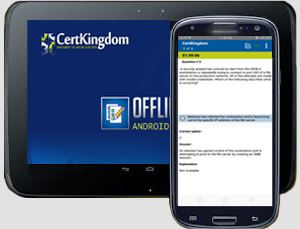
Take your learning mobile android device with all the features as desktop offline testing engine. All android devices are supported.
Supported Platforms: All Android OS EULA
Install the Android Testing Engine from google play store and download the app.ck from certkingdom website android testing engine download

Certkingdom Android Testing Engine Features
- CertKingdom Offline Android Testing Engine
- Make sure to enable Root check in Playstore
- Live Realistic practice tests
- Live Virtual test environment
- Live Practice test environment
- Mark unanswered Q&A
- Free Updates
- Save your tests results
- Re-examine the unanswered Q & A
- Make your own test scenario (settings)
- Just like the real tests: multiple choice questions
- Updated regularly, always current
