
Exam: Security-Operations-Engineer

|
|||||||||||||||||||||||||||

Certification exam guide
A Google Cloud Certified Professional Security Operations Engineer detects,
monitors, analyzes, investigates, and responds to security threats against
workloads, endpoints, and infrastructure. This individual uses Google Cloud
resources to protect an enterprise environment and is proficient in writing
detection rules, log prioritization and ingestion, orchestration, and response
automation. Further, this individual has experience leveraging posture and
threat intelligence for detection and response.
This exam assesses your knowledge of performing tasks in Google Security
Operations (SecOps) and Security Command Center (SCC). For more information on
these platforms, please refer to the Google SecOps documentation and the SCC
documentation.
Section 1: Platform operations (~14% of the exam)
1.1 Enhancing detection and response. Considerations include:
● Prioritizing telemetry sources (e.g., Security Command Center [SCC], Google
Security Operations [SecOps], GTI, Cloud IDS) to detect incidents or
misconfigurations within an enterprise environment
● Integrating multiple tools (e.g., SCC, Google SecOps, GTI, Cloud IDS,
downstream third-party system) in the security architecture to enhance detection
capabilities
● Justifying the use of tools with overlapping capabilities based on a set of
requirements
● Evaluating the effectiveness of existing tools to identify gaps in coverage
and mitigate potential threats
● Evaluating automation and cloud-based tools to enhance existing detection and
response processes
1.2 Configuring access. Considerations include:
● Configuring user and service account authentication to security tools (e.g.,
SCC, Google SecOps)
● Configuring user and service account authorization for feature access using
IAM roles and permissions
● Configuring user and service account authorization for data access using IAM
roles and permissions
● Configuring and analyzing audit logs (e.g., Cloud Audit Logs, data access
logs) for the solution
● Configuring API access for automations within security tools (e.g., service
accounts, API keys, SCC, Google SecOps, GTI)
● Provisioning identities using Workforce Identity Federation
Section 2: Data management (~14% of the exam)
2.1 Ingesting logs for security tooling. Considerations include:
● Determining approaches for data ingestion within security tools (e.g., SCC,
Google SecOps)
● Configuring an ingestion tool or features within security tools (e.g., SCC,
Google SecOps)
● Assessing required logs for detection and response, including automated
sources, within security tools (e.g., SCC Event Threat Detection, Google SecOps)
● Evaluating parsers for data ingestion in Google SecOps
● Configuring parser modifications or extensions in Google SecOps
● Evaluating data normalization techniques from log sources in Google SecOps
● Evaluating new labels for data ingestion
● Managing log and ingestion costs
2.2 Identifying a baseline of user, asset, and entity context. Considerations
include:
● Identifying relevant threat intelligence information in the enterprise
environment
● Differentiating event and entity data log sources (e.g., Cloud Audit Logs,
Active Directory organizational context)
● Evaluating event and entity data matches for enrichment by using aliasing
fields
Section 3: Threat hunting (~19% of the exam)
3.1 Performing threat hunting across environments. Considerations include:
● Developing queries to search across environment logs to identify anomalous
activity
● Analyzing user behavior to identify anomalous activity
● Investigating the network, endpoints, and services to identify threat patterns
or indicators of compromise (IOCs) using Google Cloud tools (e.g., Logs
Explorer, Log Analytics, BigQuery, Google SecOps)
● Collaborating with the incident response team to identify active threats in
the environment
● Developing hypotheses based on behavior, threat intel, posture, and incident
data (e.g., SCC, GTI) 3.2 Leveraging threat intelligence for threat hunting.
Considerations include:
● Searching for IOCs within historical logs
● Identifying new attack patterns and techniques in real time using threat
intelligence and risk assessments (e.g., GTI, detection rules, SCC toxic
combinations)
● Analyzing entity risk score to identify anomalous behavior
● Comparing and performing retrohunt of historical event data with newly
enriched logs (e.g., Google SecOps rules engine, BigQuery, Cloud Logging)
● Searching proactively for underlying threats using threat intelligence (e.g.,
GTI, detection rules)
Section 4: Detection engineering (~22% of the exam)
4.1 Developing and implementing mechanisms to detect risks and identify threats.
Considerations include:
● Reconciling threat intelligence with user and asset activity
● Analyzing logs and events to identify anomalous activity
● Assessing suspicious behavior patterns by using detection rules and searches
across various timelines
● Designing detection rules that use risk values (e.g., Google SecOps reference
lists) to identify threats matching risk profiles
● Discovering anomalous behavior of assets or users, and assigning risk values
to the detections (e.g., Google SecOps Risk Analytics, curated detection rules)
● Designing detection rules to discover posture or risk profile changes within
the environment (e.g., SCC Security Health Analytics [SHA], SCC posture
management, Google SecOps)
● Identifying new or low prevalence processes, domains, and IP addresses that do
not appear in threat intelligence sources using various methods (e.g., writing
YARA-L rules, dashboards)
● Assessing how to use entity/context data within detection rules to improve
their accuracy (e.g., Google SecOps entity graph)
● Configuring SCC Event Threat Detection custom detectors for IOCs 4.2
Leveraging threat intelligence for detection.
Considerations include:
● Scoring alerts based on the risk level of IOCs
● Using latest IOCs to search within ingested security telemetry
● Measuring the frequency of repetitive alerts to identify and reduce false
positives Section 5: Incident response (~21% of the exam) 5.1 Containing and
investigating security incidents. Considerations include:
● Collecting evidence on the scope of the incident, including forensic images
and artifacts
● Observing and analyzing alerts related to the incident using security tooling
(e.g., SCC, Google SecOps)
● Analyzing the scope of the incident using security tooling (e.g., Logs
Explorer, Log Analytics, BigQuery, Cloud Logging, Cloud Monitoring)
● Collaborating with other engineering teams for detection and long-term
remediation efforts
● Isolating affected services and processes to prevent further damage and spread
of attack
● Analyzing identified artifacts based on forensic analysis (e.g., Hash, IP,
URL, Binaries) (GTI)
● Performing root cause analysis using security tools (e.g., SCC, Google SecOps
SIEM) 5.2 Building, implementing, and using response playbooks. Considerations
include:
● Determining the appropriate response steps for automation
● Prioritizing high-value enrichments based on threat profiles
● Evaluating appropriate integrations to be leveraged by playbooks
● Designing new processes in response to newly identified attack patterns from
recent incidents
● Recommending new orchestrations and automation playbooks based on gaps in the
current implementation (e.g., Google SecOps SOAR)
● Implementing mechanisms to notify analysts and stakeholders of incidents 5.3
Implementing the case management lifecycle. Considerations include:
● Assigning cases into appropriate response stages
● Implementing efficient workflows for case escalation
● Assessing the effectiveness of case handoffs
Section 6: Observability (~10% of the exam)
6.1 Developing and maintaining dashboards and reports to provide insights.
Considerations include:
● Identifying key security analytics (e.g., metrics, KPIs, trends)
● Implementing dashboards to visualize security telemetry, ingestion metrics,
detections, alerts, and IOCs (e.g., Google SecOps SOAR, SIEM, Looker Studio)
● Generating and customizing reports (e.g., Google SecOps SOAR, SIEM) 6.2
Configuring health monitoring and alerting. Considerations include:
● Identifying important metrics for health monitoring and alerts
● Creating dashboards that centralize metrics
● Creating alerts with thresholds for specific metrics
● Configuring notifications using Google Cloud tools (e.g., Cloud Monitoring)
● Identifying health issues using Google Cloud tools (e.g., Cloud Logging)
● Configuring silent source detection
Security-Operations-Engineer Brain Dumps Exam + Online / Offline and Android Testing Engine & 4500+ other exams included
$50 - $25 (you save $25)
Buy Now
QUESTION 1
Which phase of the cloud data life cycle involves activities such as data
categorization and classification, including data labeling, marking, tagging,
and assigning metadata?
A. Store
B. Use
C. Destroy
D. Create
Answer: D
Explanation:
The cloud data life cycle defines distinct stages that data goes through from
its origin until its
disposal. The Create phase is the very first stage, and this is where data is
generated or captured by
systems, applications, or users. At this point, data does not yet have context
for storage or use, so it
must be appropriately categorized and classified. Activities like labeling,
marking, tagging, and
assigning metadata are critical because they establish the foundation for
enforcing controls
throughout the rest of the life cycle.
Classification ensures that data is aligned with sensitivity levels, regulatory
requirements, and
business value. For example, financial records may be labeled oeconfidential
while general marketing
content may be marked oepublic. These distinctions guide how encryption, access
controls, and
monitoring will be applied in subsequent phases such as storage, sharing, or
use.
According to industry frameworks, starting security at the Create phase ensures
that controls oefollow
the data across environments. Without proper classification at creation,
organizations risk
mismanaging sensitive data downstream.
QUESTION 2
Which phase of the cloud data life cycle involves the process of
crypto-shredding?
A. Destroy
B. Create
C. Archive
D. Store
Answer: A
Explanation:
The Destroy phase of the cloud data life cycle is where information is
permanently removed from
systems. A common technique in cloud environments for this phase is
crypto-shredding (or
cryptographic erasure). Rather than physically destroying the media,
crypto-shredding involves
deleting or revoking encryption keys used to protect the data. Once those keys
are destroyed, the
encrypted data becomes mathematically unrecoverable, even if the underlying
storage media remains intact.
This method is particularly useful in cloud environments where storage is
virtualized and hardware
cannot easily be physically destroyed. Crypto-shredding provides
compliance-friendly assurance that
sensitive data such as personally identifiable information (PII), financial
data, or healthcare records
cannot be accessed after retention periods expire or contractual obligations
end.
By incorporating crypto-shredding into the Destroy phase, organizations align
with standards for
secure data sanitization. This ensures legal defensibility during audits and
e-discovery and
demonstrates proper lifecycle governance. The emphasis is on making data
inaccessible while still
maintaining operational efficiency and environmental responsibility.
QUESTION 3
In most redundant array of independent disks (RAID) configurations, data is
stored across different disks. Which method of storing data is described?
A. Striping
B. Archiving
C. Mapping
D. Crypto-shredding
Answer: A
Explanation:
The method described is striping, which is a technique used in RAID
configurations to improve
performance and distribute risk. Striping involves splitting data into smaller
segments and writing
those segments across multiple disks simultaneously. For example, if a file is
divided into four parts,
each part is written to a separate disk in the RAID array.
This parallelism enhances input/output (I/O) performance because multiple drives
can be accessed
at once. It also provides resilience depending on the RAID level. While striping
by itself (RAID 0)
increases performance but not redundancy, when combined with mirroring or parity
(e.g., RAID 5 or
RAID 10), it offers both speed and fault tolerance.
The purpose of striping in the data management context is to optimize how data
is stored, accessed,
and protected. It is fundamentally different from archiving, mapping, or
crypto-shredding, as those
serve different objectives (long-term storage, logical placement, or secure
deletion). Striping is
central to high-performance storage systems and supports availability in
mission-critical environments.
QUESTION 4
As part of training to help the data center engineers understand different
attack vectors that affect
the infrastructure, they work on a set of information about access and
availability attacks that was
presented. Part of the labs requires the engineers to identify different threat
vectors and their names.
Which threat prohibits the use of data by preventing access to it?
A. Brute force
B. Encryption
C. Rainbow tables
D. Denial of service
Answer: D
Explanation:
The described threat is a Denial of Service (DoS) attack. In security contexts,
a DoS attack aims to
make a system, application, or data unavailable to legitimate users by
overwhelming resources.
Unlike brute force or rainbow table attacks, which target authentication
mechanisms, or encryption,
which is a defensive control, DoS focuses on disrupting availability”the oeA in
the Confidentiality,
Integrity, Availability (CIA) triad.
DoS can be executed in many ways: flooding a network with traffic, exhausting
server memory, or
overwhelming application processes. When scaled by multiple coordinated systems,
it becomes a
Distributed Denial of Service (DDoS) attack. In either case, the effect is the
same”authorized users
cannot access critical data or services.
For cloud environments, where service uptime is crucial, DoS protections such as
rate limiting, autoscaling,
and upstream filtering are essential. Training data center engineers to
recognize DoS helps
them understand the importance of resilience strategies and ensures continuity
planning includes
availability safeguards.
QUESTION 5
An engineer has been given the task of ensuring all of the keys used to encrypt
archival data are
securely stored according to industry standards. Which location is a secure
option for the engineer to
store encryption keys for decrypting data?
A. A repository that is made private
B. An escrow that is kept separate from the data it is tied to
C. An escrow that is kept local to the data it is tied to
D. A repository that is made public
Answer: B
Explanation:
Industry best practice requires that encryption keys are stored separately from
the data they protect.
This ensures that if the data storage system is compromised, attackers cannot
immediately decrypt
sensitive information. The use of a secure escrow system is a recognized
approach.
An escrow provides controlled storage for encryption keys, ensuring they are
only accessible by
authorized processes and not co-located with the protected data. Keeping keys
oelocal to the data
creates a single point of failure. A public or private repository without
specialized protection
mechanisms would also be insufficient due to risks of insider threats or
misconfiguration.
By placing keys in an independent escrow system, the organization enforces
separation of duties,
strengthens defense-in-depth, and aligns with cryptographic standards from NIST
and ISO.
This practice is vital when dealing with archival data, where long-term
confidentiality must be preserved
even as systems evolve.
Buy Complete
Students Feedback / Reviews/ Discussion
Weidner Steve 5 weeks, 1 day ago - Egypt
Thanks for helping me with this dump to pass my exam :) Passed with a score of
862
upvoted 4 times
Rojas Jesus 1 month ago - Peru
Passed the exam today
Just only 1 of all question have not seem.
Thanks Team
upvoted 3 times
David Loomis 1 month, 1 week ago - United States - Georgia
this is a good dump then
upvoted 3 times
Omkar Harsoo 1 month, 2 weeks ago - South Africa
Passed a few days ago with 770 - about 70-80% from here.
Solid experience with in tune
upvoted 2 times
Takeshi Kobayashi 2 months ago - Japan
Just passed with 886, i have some experience with in tune but these dumps should
be enough to pass
upvoted 11 times
logged members Can Post comments / review and take part in Discussion
Certkingdom Offline Testing Engine Simulator Download

Prepare with yourself how CertKingdom Offline Exam Simulator it is designed specifically for any exam preparation. It allows you to create, edit, and take practice tests in an environment very similar to an actual exam.
Supported Platforms: Windows-7 64bit or later - EULA | How to Install?
FAQ's: Windows-8 / Windows 10 if you face any issue kinldy uninstall and reinstall the Simulator again.
Download Offline Simulator
Certkingdom Testing Engine Features
- Certkingdom Testing Engine simulates the real exam environment.
- Interactive Testing Engine Included
- Live Web App Testing Engine
- Offline Downloadable Desktop App Testing Engine
- Testing Engine App for Android
- Testing Engine App for iPhone
- Testing Engine App for iPad
- Working with the Certkingdom Testing Engine is just like taking the real tests, except we also give you the correct answers.
- More importantly, we also give you detailed explanations to ensure you fully understand how and why the answers are correct.
Certkingdom Android Testing Engine Simulator Download
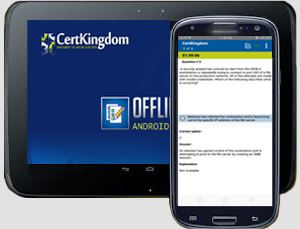
Take your learning mobile android device with all the features as desktop offline testing engine. All android devices are supported.
Supported Platforms: All Android OS EULA
Install the Android Testing Engine from google play store and download the app.ck from certkingdom website android testing engine download

Certkingdom Android Testing Engine Features
- CertKingdom Offline Android Testing Engine
- Make sure to enable Root check in Playstore
- Live Realistic practice tests
- Live Virtual test environment
- Live Practice test environment
- Mark unanswered Q&A
- Free Updates
- Save your tests results
- Re-examine the unanswered Q & A
- Make your own test scenario (settings)
- Just like the real tests: multiple choice questions
- Updated regularly, always current
