
Exam: AI-901
|
|||||||||||||||||||||||||||

Certkingdom's preparation material includes the most excellent features, prepared by the same dedicated experts who have come together to offer an integrated solution. We provide the most excellent and simple method to pass your certification exams on the first attempt "GUARANTEED"
Whether you want to improve your skills, expertise or career growth, with Certkingdom's training and certification resources help you achieve your goals. Our exams files feature hands-on tasks and real-world scenarios; in just a matter of days, you'll be more productive and embracing new technology standards. Our online resources and events enable you to focus on learning just what you want on your timeframe. You get access to every exams files and there continuously update our study materials; these exam updates are supplied free of charge to our valued customers. Get the best AI-901 exam Training; as you study from our exam-files "Best Materials Great Results"
AI-901 Exam + Online / Offline and Android Testing Engine & 4500+ other exams included
$50 - $25 (you save $25)
Buy Now
AI-901 Microsoft Azure AI Fundamentals (Updated Version) – Complete Guide
The AI-901 Microsoft Azure AI Fundamentals is an entry-level certification offered by Microsoft that validates your understanding of Artificial Intelligence (AI) and Azure AI services. This exam is ideal for beginners, students, and professionals who want to explore AI concepts without requiring deep technical experience.
This updated version focuses on real-world AI applications, cloud-based AI solutions, and Microsoft Azure tools like Azure Machine Learning, Cognitive Services, and AI workloads.
What the exam covers
AI-900 focuses on describing, rather than deeply implementing, AI workloads and Azure services. The current skills outline includes:
AI workloads and considerations (15–20%)
Common AI scenarios, types of AI (ML, computer vision, NLP, conversational AI).
Principles of responsible AI, fairness, privacy, and transparency.
Fundamental principles of machine learning on Azure (15–20%)
Basic ML terminology (features, labels, training, evaluation).
Core ML types: supervised, unsupervised, and reinforcement learning.
High-level understanding of using Azure Machine Learning for model lifecycle.
Computer vision workloads on Azure (15–20%)
Image classification, object detection, optical character recognition, facial analysis.
Awareness of services like Azure AI Vision (formerly part of Cognitive Services).
Natural Language Processing (NLP) workloads on Azure (15–20%)
Key phrase extraction, sentiment analysis, language detection, translation, Q&A.
High-level use of services such as Azure AI Language.
Generative AI workloads on Azure (20–25%)
Concepts of large language models and generative AI.
How Azure OpenAI Service fits into Azure’s AI portfolio (prompting, embeddings, content considerations).
Target audience and prerequisites
AI-900 is intended for people starting in AI solution development, business decision-makers, or anyone needing to understand Azure-based AI capabilities. No prior data science or software engineering experience is required, but:
Basic understanding of cloud concepts and client–server applications is recommended.
Familiarity with general AI and ML concepts helps but is not mandatory.
The certification can serve as a stepping stone toward role-based certifications like Azure AI Engineer Associate or Azure Data Scientist Associate, though it is not a strict prerequisite.
Certkingdom.com offers the latest AI-901 exam dumps, practice questions, and verified answers to help you pass Microsoft Azure AI Fundamentals on your first attempt.
Question: 1
You have a Microsoft Foundry project that contains an agent named Agent1.
You need to ensure that Agent1 always calls an Azure function when the agent responds to user input.
To what should you set tool_choice for Agent1?
A. auto
B. none
C. required
Answer: C
Explanation:
Microsoft’s Foundry Agent Service documentation states that tool_choice provides deterministic
control over tool calling:
auto means the model decides whether to call tools.
required means the model must call one or more tools.
none means the model does not call tools.
Therefore:
A . auto = Incorrect, because the model may or may not call the Azure function.
B . none = Incorrect, because this prevents tool/function calls.
C . required = Correct, because it forces the agent to call a tool.
The Azure OpenAI function-calling documentation also confirms that tool_choice="auto" lets the
model decide whether to call a function, while tool_choice="none" forces a user-facing response
without a tool call.
Question: 2
HOTSPOT
Select the answer that correctly completes the sentence.
Answer:
Explanation:
When content is submitted to Azure Content Understanding in Foundry Tools, the analysis is
asynchronous. This means the service does not return results immediately within the same HTTP
request. Instead, it uses the standard Azure long-running operation (LRO) pattern — you call
begin_analyze() to submit the content, which immediately returns a poller object, and then call
poller.result() to wait for processing to complete and retrieve the structured extraction results.
Why the other options are wrong:
Synchronous is incorrect — the analysis pipeline involves multiple AI steps (OCR, speech
transcription, schema mapping) that take time; a blocking synchronous call is not supported.
Returned only as unstructured plain text is incorrect — Azure Content Understanding returns richly
structured JSON output with named fields mapped to your defined schema, not plain unstructured text.
Limited to OCR-only processing is incorrect — Content Understanding goes far beyond OCR; it
supports document, audio, image, and video analyzers, and performs semantic field extraction using
AI, not just character recognition.
This asynchronous design is consistent across all Azure AI services that perform complex, multi-step
content processing.
Question: 3
DRAG DROP
You have a Microsoft Foundry project named project1 that contains an Azure OpenAI resource named
Resource1.
To Resource1, you deploy a gpt-4.1-mini model by using a model deployment named my-mini-gpt.
You need to connect to my-mini-gpt from an application.
How should you complete the Python code? To answer, drag the appropriate values to the correct
targets. Each value may be used once, more than once, or not at all.
NOTE: Each correct selection is worth one point.
Answer:
Explanation:
client = OpenAI(
api_key="...",
base_url="https://resource1.openai.azure.com/openai/v1/",
)
response = client.responses.create(
model="my-mini-gpt",
...
)
For Azure OpenAI in Microsoft Foundry, the base_url uses the Azure OpenAI resource name in the
endpoint format:
https://
In the question, the Azure OpenAI resource is named Resource1, so the first blank must be resource1.
Microsoft documentation for Azure OpenAI v1 endpoints confirms that the endpoint must use the
...openai.azure.com/openai/v1/ path.
Questions and Answers PDF 4/48
For the model parameter, Azure OpenAI requires the deployment name, not the underlying model
name. Microsoft states that Azure OpenAI always requires the deployment name when calling APIs,
even when the parameter is named model.
The deployed model is gpt-4.1-mini, but the deployment name is my-mini-gpt. Therefore, the second
blank must be:
model="my-mini-gpt"
So the correct selections are:
base_url blank = resource1
model blank = my-mini-gpt
Question: 4
What are two purposes of instructions when prompting a generative AI model? Each correct answer presents part of the solution.
NOTE: Each correct selection is worth one point.
A. defines constraints on the model's responses
B. defines the agent's role and behavior
C. defines the Azure region where inference occurs
D. selects which model to use
E. defines the tokens per minute (TPM) allocation for the model
Answer: A, B
Explanation:
Microsoft Foundry Agent Service documentation states that instructions define goals, constraints,
and behavior for an agent. Therefore, instructions are used to guide how the generative AI model or
agent should respond and behave.
Option A is correct because instructions can define constraints the model must follow.
Option B is correct because instructions can define the agent’s role and behavior.
Options C, D, and E are incorrect because Azure region, model selection, and TPM allocation are
configuration or deployment/resource settings, not purposes of prompt instructions.
Question: 5
You are developing an application that analyzes voicemail recordings by using Azure Content
Understanding in Foundry Tools.
You need to extract a transcript and structured information from the recordings.
Which type of analyzer should you use?
A. document analyzer
B. video analyzer
C. audio analyzer
D. image analyzer
Answer: C
Explanation:
Voicemail recordings are audio content. Azure Content Understanding analyzers define what type of
content to process, including documents, images, audio, or video, and what elements to extract,
including transcripts and structured fields.
Microsoft’s custom analyzer documentation also shows an audio example based on prebuilt-audio
for processing customer support call recordings, which is the same content type as voicemail recordings.
Therefore, to extract a transcript and structured information from voicemail recordings, you should use an audio analyzer.
Why Choose AI-901 Certification?
Beginner-friendly AI certification
No coding experience required
High demand in cloud and AI careers
Foundation for advanced Azure certifications
Recognized globally by employers
Ali Khan (Pakistan) – Passed AI-901 easily with these practice questions.
John Smith (USA) – Great content, very close to real exam.
Maria Lopez (Spain) – Helped me understand AI concepts clearly.
Ahmed Hassan (UAE) – Accurate dumps and easy explanations.
Chen Wei (China) – Perfect for beginners in Azure AI.
David Brown (UK) – Passed on first attempt, highly recommended.
Sara Ahmed (Egypt) – Excellent preparation material.
Lucas Martin (France) – Updated questions made a big difference.
Priya Sharma (India) – Very helpful and easy to follow.
James Wilson (Canada) – Best resource for quick preparation.
What Students Commonly Ask ChatGPT About AI-901
Here are the most frequent queries students ask:
Is AI-901 easy to pass for beginners?
What are the best study materials for AI-901?
How many questions are in the AI-901 exam?
What is the passing score for AI-901?
Are dumps helpful for passing AI-901?
How long does it take to prepare?
Is coding required for AI-901?
What is the exam format and duration?
Which Azure services should I focus on?
Are practice tests enough to pass?
Certkingdom.com offers the latest AI-901 exam dumps, practice questions, and verified answers to help you pass Microsoft Azure AI Fundamentals on your first attempt.
Certkingdom.com offers the latest AI-901 exam dumps, pr10 Most Asked FAQs About AI-901 Exam
1. What is AI-901 exam?
It is a beginner-level certification that tests knowledge of AI concepts and Azure AI services.
2. Is AI-901 difficult?
No, it is designed for beginners with basic understanding.
3. Do I need coding skills?
No coding is required for this exam.
4. What is the passing score?
Typically, 700 out of 1000.
5. How many questions are there?
Around 40–60 questions.
6. What is the exam duration?
Approximately 60 minutes.
7. Can I pass using dumps?
Practice tests can help, but understanding concepts is important.
8. Is AI-901 worth it?
Yes, it’s a great entry point into AI and cloud careers.
9. How long should I study?
1–3 weeks depending on your background.
10. What comes after AI-901?
You can move to advanced certifications like Azure AI Engineer Associate.actice questions, and verified answers to help you pass Microsoft Azure AI Fundamentals on your first attempt.
Make yourself more valuable in today's competitive computer industry Certkingdom's preparation material includes the most excellent features, prepared by the same dedicated experts who have come together to offer an integrated solution. We provide the most excellent and simple method to pass your Microsoft Microsoft Azure AI-901 exam on the first attempt "GUARANTEED".
Unlimited Access Package
will prepare you for your exam with guaranteed results, AI-901 Study Guide. Your exam will download as a single AI-901 PDF or complete AI-901 testing engine as well as over +4000 other technical exam PDF and exam engine downloads. Forget buying your prep materials separately at three time the price of our unlimited access plan - skip the AI-901 audio exams and select the one package that gives it all to you at your discretion: AI-901 Study Materials featuring the exam engine.
Certkingdom AI-901 Exam Prepration Tools
Certkingdom Microsoft Microsoft Azure preparation begins and ends with your accomplishing this credential goal. Although you will take each Microsoft Microsoft Azure online test one at a time - each one builds upon the previous. Remember that each Microsoft Microsoft Azure exam paper is built from a common certification foundation.
AI-901 Exam Testing Engines
Beyond knowing the answer, and actually understanding the AI-901 test questions puts you one step ahead of the test. Completely understanding a concept and reasoning behind how something works, makes your task second nature. Your AI-901 quiz will melt in your hands if you know the logic behind the concepts. Any legitimate Microsoft Microsoft Azure prep materials should enforce this style of learning - but you will be hard pressed to find more than a Microsoft Microsoft Azure practice test anywhere other than Certkingdom.
AI-901 Exam Questions and Answers with Explanation
This is where your Microsoft Microsoft Azure AI-901 exam prep really takes off, in the testing your knowledge and ability to quickly come up with answers in the AI-901 online tests. Using Microsoft Azure AI-901 practice exams is an excellent way to increase response time and queue certain answers to common issues.
AI-901 Exam Study Guides
All Microsoft Microsoft Azure online tests begin somewhere, and that is what the Microsoft Microsoft Azure training course will do for you: create a foundation to build on. Study guides are essentially a detailed Microsoft Microsoft Azure AI-901 tutorial and are great introductions to new Microsoft Microsoft Azure training courses as you advance. The content is always relevant, and compound again to make you pass your AI-901 exams on the first attempt. You will frequently find these AI-901 PDF files downloadable and can then archive or print them for extra reading or studying on-the-go.
AI-901 Exam Video Training
For some, this is the best way to get the latest Microsoft Microsoft Azure AI-901 training. However you decide to learn AI-901 exam topics is up to you and your learning style. The Certkingdom Microsoft Microsoft Azure products and tools are designed to work well with every learning style. Give us a try and sample our work. You'll be glad you did.
AI-901 Other Features
* Realistic practice questions just like the ones found on certification exams.
* Each guide is composed from industry leading professionals real Microsoft Microsoft Azurenotes, certifying 100% brain dump free.
* Study guides and exam papers are guaranteed to help you pass on your first attempt or your money back.
* Designed to help you complete your certificate using only
* Delivered in PDF format for easy reading and printing Certkingdom unique CBT AI-901 will have you dancing the Microsoft Microsoft Azure jig before you know it
* Microsoft Azure AI-901 prep files are frequently updated to maintain accuracy. Your courses will always be up to date.
Get Microsoft Azure ebooks from Certkingdom which contain real AI-901 exam questions and answers. You WILL pass your Microsoft Azure exam on the first attempt using only Certkingdom's Microsoft Azure excellent preparation tools and tutorials.
These are real testimonials. Hi friends! CertKingdom.com is No1 in sites coz in $50 I cant believe this but when I purchased the $50 package it was amazing I Microsoft passed 10 Exams using CertKingdom guides in one Month So many thanks to CertKingdom Team , Please continue this offer for next year also. So many Thanks
Mike CA
Thank You! I would just like to thank CertKingdom.com for the Microsoft Microsoft Azure AI-901 test guide that I bought a couple months ago and I took my test and pass overwhelmingly. I completed the test of 125 questions in about 90 minutes I must say that their Q & A with Explanation are very amazing and easy to learn.
Jay Brunets
After my co-workers found out what I used to pass Microsoft Microsoft Azure AI-901 the test, that many are thinking about purchasing CertKingdom.com for their Microsoft Azure exams, I know I will again
John NA
I passed the Microsoft Microsoft Azure AI-901 exam yesterday, and now it's on to security exam. Couldn't have done it with out you. Thanks very much.
Oley R.
Hello Everyone
I Just Passed The Microsoft Microsoft Azure AI-901 Took 80 to 90 Minutes max to understand and easy to learn. Thanks For Everything Now On To AI-901
Robert R.
Hi CertKingdom.com thanks so much for your assistance in Microsoft Microsoft Azure i passed today it was a breeze and i couldn't have done it without you. Thanks again
Seymour G.
I have used your Exam Study Guides for preparation for Microsoft Microsoft Azure AI-901. I also passed all those on the first round. I'm currently preparing for the Microsoft and theMicrosoft Azure. exams
Ken T.
I just wanted to thank you for helping me get myMicrosoft Azure $50 package for all guides is awesome you made the journey a lot easier. I passed every test the first time using your Guide
Mario B.
I take this opportunity to express my appreciation to the authors of CertKingdom.com Microsoft Microsoft Azure test guide. I purchased the AI-901 soon after my formal hands on training and honestly, my success in the test came out of nowhere but CertKingdom.com. Once again I say thanks
Kris H.
Dear CertKingdom.com team the test no. AI-901 that i took was very good, I received 880 and could have gain more just by learning your exams
Gil L.
Hi and Thanks I have just passed the Microsoft Azure Directory Services Design exam with a score of 928 thanks to you! The guide was excellent
Edward T.
Great stuff so far....I love this site....!! I am also on the Microsoft Microsoft Azure I decided to start from certkingdom and start learning study Microsoft Azure from home... It has been really difficult but so far I have managed to get through 4 exams....., now currently studying for the more exams.... Have a good day.................................................. Cheers
Ted Hannam
Thanks for your Help, But I have finally downloaded Microsoft Microsoft Azure AI-901 exam preparation from certkingdom.com they are provided me complete information about the exam, lets hope I get success for the AI-901 exam, I found there exams very very realistic and useful. thanks again
lindsay Paul
Certkingdom Offline Testing Engine Simulator Download

Prepare with yourself how CertKingdom Offline Exam Simulator it is designed specifically for any exam preparation. It allows you to create, edit, and take practice tests in an environment very similar to an actual exam.
Supported Platforms: Windows-7 64bit or later - EULA | How to Install?
FAQ's: Windows-8 / Windows 10 if you face any issue kinldy uninstall and reinstall the Simulator again.
Download Offline Simulator-Beta
Certkingdom Testing Engine Features
- Certkingdom Testing Engine simulates the real exam environment.
- Interactive Testing Engine Included
- Live Web App Testing Engine
- Offline Downloadable Desktop App Testing Engine
- Testing Engine App for Android
- Testing Engine App for iPhone
- Testing Engine App for iPad
- Working with the Certkingdom Testing Engine is just like taking the real tests, except we also give you the correct answers.
- More importantly, we also give you detailed explanations to ensure you fully understand how and why the answers are correct.
Certkingdom Android Testing Engine Simulator Download
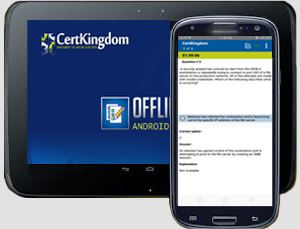
Take your learning mobile android device with all the features as desktop offline testing engine. All android devices are supported.
Supported Platforms: All Android OS EULA
Install the Android Testing Engine from google play store and download the app.ck from certkingdom website android testing engine download

Certkingdom Android Testing Engine Features
- CertKingdom Offline Android Testing Engine
- Make sure to enable Root check in Playstore
- Live Realistic practice tests
- Live Virtual test environment
- Live Practice test environment
- Mark unanswered Q&A
- Free Updates
- Save your tests results
- Re-examine the unanswered Q & A
- Make your own test scenario (settings)
- Just like the real tests: multiple choice questions
- Updated regularly, always current
