
Exam: PEGAPCDC87V1

|
|||||||||||||||||||||||||||

Exam Code: PEGAPCDC87V1
Language: English | French
Retirement Date: N/A
Number of Questions: 60 Questions
Duration: 1 hr 30 mins
Passing Score: 70%
The Certified Pega Decisioning Consultant certification is for professionals
participating in the design and development of a Pega Customer Decision Hub™
solution. This certification ensures you have the skills to apply design
principles of Next-Best-Action Designer, Decision Strategies, and Predictive
Analytics. The exam includes multiple choice, scenario, and drag/drop questions.
Prerequisites
Decisioning Consultant
Next-Best-Action concepts (9%)
One-to-one customer engagement
Optimize the customer value in the contact center
Essentials of always-on outbound
Define the starting population
Actions and treatments (14%)
Define and manage customer actions
Present a single offer on the web
Define an action for outbound
Engagement policies (11%)
Define customer engagement policies
Create an engagement strategy
Contact policy and volume constraints (12%)
Avoid overexposure of actions
Avoid overexposure of actions on outbound
Limit action volume on outbound
AI and Arbitration (9%)
Action arbitration
Action prioritization with AI
Prioritize actions with business levers
Channels (11%)
Real-time containers
Create a real-time container
Send offer emails
Share action details with third-party distributors
Decision strategies (26%)
Create and understand decision strategies
Create engagement strategies using customer credit score
Create eligibility rules using customer risk segments
Business agility for 1:1 customer engagement (9%)
Agility in a customer engagement project
Change management process
Building your business operations team
Life cycle of a change request
Change request types
Launching a new offer on web
Updating existing actions
Implementing business changes in revision management
PEGAPCDC87V1 Brain Dumps Exam + Online / Offline and Android Testing Engine & 4500+ other exams included
$50 - $25 (you save $25)
Buy Now
QUESTION 1
When a customer is offered an action that they already accepted, this is
because_________.
A. the strategy is not customized to exclude previously accepted offers
B. there are no suppression rules defined
C. the actions are filtered based on eligibility
D. the customer intent was captured incorrectly
Answer: A
Explanation:
ï‚ꞏ Identify the issue: When a customer receives an offer they have already
accepted, it suggests that
the decision strategy did not consider previous interactions.
ï‚ꞏ Check strategy customization: Strategies in Pega CDH can be customized to
include rules that prevent the same offer from being presented again.
ï‚ꞏ Confirm the exclusion of previous offers: Specifically, you need to ensure
that there is a suppression rule or a logic to check the Interaction History to
exclude previously accepted offers.
ï‚ꞏ Reference: Refer to the section on "Next-Best-Action Designer constraints"
and "Engagement policies" in the Pega Customer Decision Hub User Guide. These
sections explain how to configure rules to prevent repetitive offersï‚ꞏ.
QUESTION 2
The following decision strategy outputs the most profitable shoe a retailer
can sell.
The profit is the selling Price of the shoe, minus the Cost to acquire the shoe.
The details of the shoes are provided in the following table:
According to the decision strategy, what is the output of component in the blank
space highlighted in red?
A. Nike, Adidas, Puma, Reebok
B. Reebok, Puma, Adidas, Nike
C. Reebok
D. Nike
Answer: C
Explanation:
ï‚ꞏ Understand the strategy objective: The decision strategy is designed to
output the most profitable shoe. The profit is calculated as Profit = Price -
Cost.
ï‚ꞏ Evaluate the provided data:
Nike: Profit = $69 - $59 = $10
Adidas: Profit = $65 - $45 = $20
Puma: Profit = $85 - $65 = $20
Reebok: Profit = $75 - $50 = $25
ï‚ꞏ Determine the most profitable shoe: According to the calculations, Reebok
has the highest profit ($25).
ï‚ꞏ Fill in the blank: Therefore, the output of the component in the blank space
highlighted in red should be Reebok, which has the highest profit.
ï‚ꞏ Reference: The strategy design and output decision rules are outlined in the
sections on "Understanding Next-Best-Action Designer arbitration" and
"Next-Best-Action strategy framework components" in the Pega Customer Decision
Hub User Guideï‚ꞏ.
QUESTION 3
The following decision strategy outputs the most profitable shoe a retailer
can sell.
The profit is the selling Price of the shoe, minus the Cost to acquire the shoe.
The details of the shoes are provided in the following table:
What is the number of outputs that each component has?
A. Set-Property=1, Results=4
B. Set-Property=4, Results=4
C. Set-Property=1, Results=1
D. Set-Property=4, Results=1
Answer: B
Explanation:
Set-Property Component: This component performs the calculation of profit for
each of the four
brands (Nike, Adidas, Puma, Reebok). Since the Set-Property component is
configured to calculate
profit for each brand individually, it processes four inputs, resulting in four
outputs.
Reference: Pega Decisioning and Strategy documentation indicates that each input
passing through
the Set-Property component results in a corresponding output, reflecting the
application of the
defined operation to each input.
Results Component: This component collects the outputs from the Set-Property
component and
simply passes them through, leading to four outputs.
Reference: Based on the decision strategy framework, the Results component
consolidates the
outputs from the prior component and maintains the count of outputs it receives.
Thus, both components handle and produce outputs corresponding to each brand
processed, which are four in total
QUESTION 4
U+ Bank uses a scorecard rule in a decision strategy to compute the mortgage
limit for a customer.
U+ Bank updated their scorecard to include a new property in the calculation:
customer income.
What changes do you need to make in the decision strategy for the updated
scorecard to take effect?
A. Remap the scorecard property in the decision strategy for the change to take
effect.
B. Add a new Group By component for the mortgage limit calculation.
C. The score calculation is independent of the strategy and no change is
required.
D. A new proposition filter needs to be configured in the strategy to filter on
customer income.
Answer: A
Explanation:
Updating Scorecard in Decision Strategy: When a scorecard rule is updated to
include a new property
such as customer income, it is essential to reflect this change in the decision
strategy. The scorecard
properties must be correctly mapped to ensure the new calculations are utilized.
Reference: According to Pega's guidelines for integrating scorecard updates
within decision
strategies, any changes in the scorecard attributes require remapping within the
decision strategy to
ensure the new data is correctly processed and utilized in decision-making.
QUESTION 5
To reference a customer property in a strategy, you need to prefix the property
name with the keyword______________.
A. '' .''
B. "Customer."
C. "Data."
D. No prefix. Use directly the property name.
Answer: B
Explanation:
Referencing Customer Properties: In Pega decision strategies, customer
properties are accessed by
logged members Can Post comments / review and take part in Discussion
Certkingdom Offline Testing Engine Simulator Download

Prepare with yourself how CertKingdom Offline Exam Simulator it is designed specifically for any exam preparation. It allows you to create, edit, and take practice tests in an environment very similar to an actual exam.
Supported Platforms: Windows-7 64bit or later - EULA | How to Install?
FAQ's: Windows-8 / Windows 10 if you face any issue kinldy uninstall and reinstall the Simulator again.
Download Offline Simulator-Beta
Certkingdom Testing Engine Features
- Certkingdom Testing Engine simulates the real exam environment.
- Interactive Testing Engine Included
- Live Web App Testing Engine
- Offline Downloadable Desktop App Testing Engine
- Testing Engine App for Android
- Testing Engine App for iPhone
- Testing Engine App for iPad
- Working with the Certkingdom Testing Engine is just like taking the real tests, except we also give you the correct answers.
- More importantly, we also give you detailed explanations to ensure you fully understand how and why the answers are correct.
Certkingdom Android Testing Engine Simulator Download
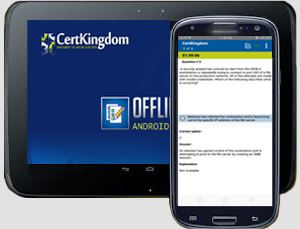
Take your learning mobile android device with all the features as desktop offline testing engine. All android devices are supported.
Supported Platforms: All Android OS EULA
Install the Android Testing Engine from google play store and download the app.ck from certkingdom website android testing engine download

Certkingdom Android Testing Engine Features
- CertKingdom Offline Android Testing Engine
- Make sure to enable Root check in Playstore
- Live Realistic practice tests
- Live Virtual test environment
- Live Practice test environment
- Mark unanswered Q&A
- Free Updates
- Save your tests results
- Re-examine the unanswered Q & A
- Make your own test scenario (settings)
- Just like the real tests: multiple choice questions
- Updated regularly, always current
