
Exam: 1Z0-1067-21

|
|||||||||||||||||||||||||||

Introduction
The Oracle Cloud Infrastructure (OCI) 2019 Cloud Operations Associate exam
(1Z0-1067) exam is designed for individuals who possess a strong foundation
knowledge in managing and operating infrastructure using Oracle Cloud
Infrastructure services. This certification validates understanding of OCI
services to control and operate infrastructure, such as but not limited to:
monitoring, automation, cost control, data retention and security control. This
certification is available to all professionals.
Target Audience
An Operations Administrator:
• is responsible for ongoing support and management of solutions deployed in the
cloud
• has a strong understanding of cloud computing concepts
• knows all components of OCI
• builds a highly resilient infrastructure in cloud
• translates on-premises operations to a typical cloud based infrastructure.
Certification Details
• Certification Name: Oracle Cloud Infrastructure 2020 Cloud Operations
Associate | 1Z0-1067-20
• Target Audience: Professionals responsible for managing Oracle Cloud
Infrastructure services
• Platform: Available on Oracle University and delivered via Pearson VUE
• Exam Duration: 85 minutes
• Number of Questions: 55
• Exam Cost: $150 (25% discount on this list price if you are OPN (Oracle
Partner Network) and have the OPN number with you while registering for the
exam)
• Passing Score: 70%
Certification Benefits
• Stand out amongst world-wide cloud professionals by establishing industry
capability in world-class technology!
• Validate your skills and knowledge on how to create infrastructure solutions
using Oracle Cloud Infrastructure Services.
• Secure a digital badge for your social media profile to demonstrate your
credibility in the industry. (https://www.youracclaim.com/org/oracle/badge/oracle-cloud-infrastructure2019-cloud-operations-associate)
Exam Topics
This exam is revised regularly to align with training and service release
updates. The following table lists the exam objectives, followed by concepts
that may be tested in this section.
# Objective
Concepts possibly tested in section
1 Automating Cloud Tasks
1.1 Use the OCI CLI to simplify repetitive tasks Understand and implement
automation of OCI services using Terraform.
1.2 Utilize configuration management tools to control infrastructure
1.3 Manage infrastructure as code
1.4 Explain user resource manager processes to implement infrastructure as code
2 Performance Tuning and Troubleshooting
2.1 Explain Troubleshooting resource availability and accessibility
Getting alerts for issues and validating problem, with being able to implement a
fix. 2.2 Validate OCI performance
3 Managing Cost
3.1 Utilize billing tags to track cost Using cost management and automating the
control of account spend with tags, and email notification.
3.2 Explain how to Implement billing alerts
3.3 Leverage automation to control cost
4 Security and Compliance
4.1 Create secure access control policies Understand and implement Identity an
Access management. Deploy security throughout OCI.
4.2 Leverage compartments for resource isolation
4.3 Audit cloud access
5 Monitoring and Alerting
5.1 Understand Metric Query Language (MQL) Using alarms and alerts to increase
visibility into OCI services.
5.2 Create and managing alarms
5.3 Implement automated notifications
6 Data Retention and Archival
6.1 Use Object Storage Lifecycle policies for tiered data storage Using your
skills and understanding of object storage, and block volumes to achieve correct
RTO and RPO.
6.2 Manage automated block storage and database backups
6.3 Implement cross-region data copy strategies
7 Designing for cloud-scale agility
7.1 Utilize edge services for automated failover / recovery
Create an environment that will be resilient.
Exam Preparation
To successfully prepare for the 1Z0-1067 -Oracle Cloud Operations Associate
2019 exam certification, it is recommended that you have a minimum of 6 months
of hands-on job or industry experience in managing or implementing cloud
infrastructures (preferably an Oracle Cloud Infrastructure (OCI) tenancy). If
you are unable to obtain hands-on experience, it is strongly recommended that
you get as much practice as possible in labs or test environments. We also
highly recommend that you become familiar with the content covered below.
Oracle Cloud Infrastructure (OCI) training is frequently updated to reflect the
OCI services. We recommend that you reference the latest documentation to ensure
that you have the latest information about the services.
Here is the recommended learning path for an individual to successfully prepare
for the OCI Cloud Operations Associate certification:
1Z0-1067-21 Brain Dumps Exam + Online / Offline and Android Testing Engine & 4500+ other exams included
$50 - $25 (you save $25)
Buy Now
QUESTION 1
You are asked to deploy a new application that has been designed to scale
horizontally. The business
stakeholders have asked that the application be deployed In us-phoenlx-1.
Normal usage requires 2 OCPUs. You expect to have few spikes during the week,
that will require up
to 4 OCPUs, and a major usage uptick at the end of each month that will require
8 OCPUs.
What is the most cost-effective approach to implement a highly available and
scalable solution?
A. Create an instance pool with a VM.Standard2.2 shape instance configuration.
Setup the
autoscaling configuration to use 2 availability domains and have a minimum of 2
instances, to handle
the weekly spikes, and a maximum of 4 Instances.
B. Create an instance with 1 OCPU shape. Use a CLI script to clone It when more
resources are needed.
C. Create an instance pool with a VM.Standard2.1 shape instance configuration.
Setup the
autoscaling configuration to use 2 availability domains and have a minimum of 2
instances and a maximum of 8 instances.
D. Create an instance with 1 OCPU shape. Use the Resize Instance action to scale
up to a larger shape when more resources are needed.
Answer: A
Explanation:
Instance pools let you provision and create multiple Compute instances based off
the same instance
configuration, within the same region. They also enable integration with other
services, such as the
Load Balancing service and IAM service, making it easier to manage groups of
instances
You create an instance pool using an existing instance configuration.
You can automatically adjust the number of instances in an instance pool based
on performance
metrics such as CPU utilization.
Autoscaling lets you automatically adjust the number of Compute instances in an
instance pool based
on performance metrics such as CPU utilization. This helps you provide
consistent performance for
your end users during periods of high demand, and helps you reduce your costs
during periods of low demand.
QUESTION 2
As the operations administrator for your company's Oracle Cloud Infrastructure (OCI),
you have been
entrusted the task of ensuring that data being accessed by the application is
encrypted.
Your application portfolio Includes both Virtual Machine (VM) and Bare Metal
(BM) database systems.
Which method should you use to achieve encryption of data in-transit?
A. Configure backup encryption for RMAN backup sets before transferring data
B. Native Oracle Net Services encryption and integrity capabilities
C. Key Store/Wallet service for on the fly encryption of data in transit
D. Data is encrypted at rest using TDE and no additional encryption is needed
Answer: B
Explanation:
In Oracle Database Cloud Service databases, data security is provided for data
in transit and data at
rest. Security of data in transit is achieved through network encryption.
Security of data at rest is
achieved through encryption of data stored in database data files and backups.
To secure connections to your Oracle Database Cloud Service databases, you can
use native Oracle
Net Services encryption and integrity capabilities.
Encryption of network data provides data privacy so that unauthorized parties
are not able to view
data as it passes over the network. In addition, integrity algorithms protect
against data modification
and illegitimate replay.
QUESTION 3
You have deployed a three-tier web application inside an Oracle Cloud
Infrastructure (OCI) VCN with
a CIDR block of 10.0.0.0. You Initially deploy three web servers
(VM.Standard2.2), two application
servers (VM.Standard2.4), and two servers (VM.Standard2.8) running Oracle
database.
The web, application and database servers are deployed across two availability
domains in the usashburn- 1 region.
You also deployed a Public Load Balancer In front of the two web servers. The
web traffic gradually
Increases In the first few days following the deployment, so you attempt to
double the number of
instances in each tier of the application to handle the new load. Unfortunately,
some of these new
Instances fail to launch.
Your tenancy comes with the following set of predefined services limits for the
availability domain
and compartment where the application is deployed.
What is a possible reason for this deployment to fail?
A. You do not have enough private IP addresses left to launch all of the new
compute instances.
B. You do not have sufficient public IP addresses required by the web,
application and database servers.
C. You do not have sufficient quotas for number of VM.Standard2.2,
VM.Standard2.4 and
VM.Standard2.8 shapes in the Production compartment in the us-ashburn-1 region.
D. You do not have sufficient quotas for number of VM.Standard2.2,
VM.Standard2.4 and
VM.Standard2.8 shapes in each availability domain in the us-ashburn-1 region.
Answer: A
Explanation:
Each subnet in a VCN consists of a contiguous range of IPv4 addresses that do
not overlap with other
subnets in the VCN.
In our case the VPN is use 10.0.0.0 and by default The first two IPv4 addresses
and the last in the
subnet's CIDR are reserved by the Networking service. so will have 13 free IPs
should be used in this VCN
We have already 3 web + 2 app +2 DB (7 IPs used for instances). in addition to 2
Private IPs for Load
balance. that will give us 4 IPs only available in the Subnet that not allow us
to double the VMs
QUESTION 4
A subscriber of on Oracle Cloud Infrastructure (OCI) Notifications service
topic complained about not
receiving messages from the service. Which of the following options can help you
debug this issue?
A. If OCI Notifications service does not receive an acknowledgement from a
subscription endpoint,
the service tries to redeliver messages for up to two hours. Configure an alarm
on the
NumberofNotificationFailed metric through the OCI Monitoring service to help
debug the issue.
B. If OCI Notifications service does not receive an acknowledgement from a
subscription endpoint,
the service drops the message. Confirm that the subscriber is always online to
receive messages to
help debug the issue.
C. If OCI Notifications service does not receive an acknowledgement from a
subscription endpoint,
the service tries to redeliver messages for up to one day. Make sure that the
subscriber is online at
least once a day to help debug the Issue.
D. If OCI Notifications service does not receive an acknowledgement from a
subscription endpoint,
check the NumberofNotificationFailed metric through the OCI Monitoring service
for failed
messages. Copy these messages to an OCI Object Storage bucket. Make sure the
subscriber has the
required credentials to access this bucket to help debug the Issue
Answer: A
Explanation:
The Oracle Cloud Infrastructure Notifications service broadcasts messages to
distributed
components through a publish-subscribe pattern, delivering secure, highly
reliable, low latency and
durable messages for applications hosted on Oracle Cloud Infrastructure and
externally. Use
Notifications to get notified when event rules are triggered or alarms are
breached, or to directly
publish a message.
If Notifications doesnt receive an acknowledgement from a subscription endpoint,
the service tries
to redeliver messages for up to two hours. This situation can occur when the
endpoint is offline.
You can configure an alarm on the NumberOfNotificationFailed metric through the
Monitoring service
QUESTION 5
The boot volume on your Oracle Linux instance has run out of space. Your
application has crashed
due to a lack of swap space, forcing you to Increase the size of the boot
volume.
Which step should NOT be Included In the process used to solve the Issue?
A. Resize the boot volume by specifying a larger value than the boot volume's
current size.
B. Create a RAID 0 configuration to extend the boot volume file system onto
another block volume.
C. Attach the resized boot volume to a second instance as a data volume; Extend
the partition and grow the file system on the resized boot volume.
D. Reattach the boot volume and restart the instance.
E. Stop the instance and detach the boot volume.
Answer: B
Explanation:
The Oracle Cloud Infrastructure Block Volume service lets you expand the size of
block volumes and
boot volumes. You have three options to increase the size of your volumes:
- Expand an existing volume in place with offline resizing. See Resizing a
Volume Using the
Console for the steps to do this.
- Restore from a volume backup to a larger volume. See Restoring a Backup to a
New
Volume and Restoring a Boot Volume.
- Clone an existing volume to a new, larger volume. See Cloning a Volume and
Cloning a Boot Volume.
QUESTION 6
You are working as a Cloud Operations Administrator for your company. They have
different Oracle
Cloud Infrastructure (OCI) tenancies for development and production workloads.
Each tenancy has
resources in two regions - uk-london-1 and eu-frankfurt-1. You are asked to
manage all resources and
to automate all the tasks using OCI Command Line Interface (CLI).
Which is the most efficient method to manage multiple environments using OCI CLI?
A. Create environment variables for the sets of credentials that align to each
combination of tenancy, region, and environment.
B. Use OCI CLI profiles to create multiple set of credentials in your config
file, and reference the appropriate profile at runtime.
C. Use different bash terminals for each environment.
D. Run OCI setup config to create new credentials for each environment every
time you want to access the environment.
Answer: B
Explanation:
The Oracle Cloud Infrastructure CLI configuration file can contain several
profiles. and you can create
multiple profiles with different values, then you can specify which profile to
load.
Example Configuration
[DEFAULT]
user=ocid1.user.oc1..<unique_ID>
fingerprint=<your_fingerprint>
Buy Complete
Certainly, here's a rewritten version of your text:
Packiam Vijendran 1 months ago - Malaysia
Passed the exam yesterday, 95% of the question were from this site. Note: Pay
more attention to all the community discussions on each question, instead of the
answers provided by the examtopics and I strongly suggest to get the contributor
access.
upvoted 4 times
Javier Cardaba Enjuto 2 months, 1 week ago - Spain
Excellent pre-exam session tool
upvoted 2 times
Palanisamy Arulmohan 1 months, 1 week ago - USA
I passed today, 94 questions asked and 99% of them were in this dump.
3 labs: BGP (as-override), HSRP, OSPF (without network statement)
upvoted 4 times
peppinauz 3 months, 2 weeks ago
I pass my exam, dump is valid about 90-95%. review the community answers!!
upvoted 6 times
Oberoi Ankit3 months, 3 weeks ago - USA Texas
Passed exam today dump still accurate. almost all the questions are here, some
are overcomplicated or incomplete on the site,
upvoted 4 times
logged members Can Post comments / review and take part in Discussion
Certkingdom Offline Testing Engine Simulator Download

Prepare with yourself how CertKingdom Offline Exam Simulator it is designed specifically for any exam preparation. It allows you to create, edit, and take practice tests in an environment very similar to an actual exam.
Supported Platforms: Windows-7 64bit or later - EULA | How to Install?
FAQ's: Windows-8 / Windows 10 if you face any issue kinldy uninstall and reinstall the Simulator again.
Download Offline Simulator-Beta
Certkingdom Testing Engine Features
- Certkingdom Testing Engine simulates the real exam environment.
- Interactive Testing Engine Included
- Live Web App Testing Engine
- Offline Downloadable Desktop App Testing Engine
- Testing Engine App for Android
- Testing Engine App for iPhone
- Testing Engine App for iPad
- Working with the Certkingdom Testing Engine is just like taking the real tests, except we also give you the correct answers.
- More importantly, we also give you detailed explanations to ensure you fully understand how and why the answers are correct.
Certkingdom Android Testing Engine Simulator Download
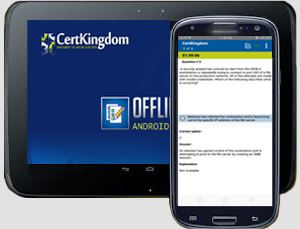
Take your learning mobile android device with all the features as desktop offline testing engine. All android devices are supported.
Supported Platforms: All Android OS EULA
Install the Android Testing Engine from google play store and download the app.ck from certkingdom website android testing engine download

Certkingdom Android Testing Engine Features
- CertKingdom Offline Android Testing Engine
- Make sure to enable Root check in Playstore
- Live Realistic practice tests
- Live Virtual test environment
- Live Practice test environment
- Mark unanswered Q&A
- Free Updates
- Save your tests results
- Re-examine the unanswered Q & A
- Make your own test scenario (settings)
- Just like the real tests: multiple choice questions
- Updated regularly, always current
