
Exam: SD-WAN-Engineer

|
|||||||||||||||||||||||||||

SD-WAN-Engineer validate skills across vendors like Palo Alto Networks (Prisma
SD-WAN), Cisco, and MEF, covering design, deployment, management, security, and
troubleshooting in vendor-neutral or specific platforms, with details varying by
vendor (e.g., Palo Alto: $250, Pearson VUE; MEF: $420, 50 Qs/90 min). Key
aspects include architecture, policy design, operations, troubleshooting, and
often align with SASE/security roles, preparing engineers for high-demand
network transformation.
This certification is designed for technical professionals who deploy, manage,
and troubleshoot Prisma SD-WAN environments. Ideal candidates include
SD-WAN/SASE engineers, professional services consultants, and network
engineers/administrators.
Key SD-WAN Certifications & Details
Here are details for major SD-WAN engineer certifications:
1. Palo Alto Networks SD-WAN Engineer (Prisma SD-WAN)
Focus: End-to-end Prisma SD-WAN lifecycle (planning, design, deployment,
management, troubleshooting).
Audience: Network/Security Engineers, SASE specialists.
Format: Multiple-choice, English, Pearson VUE.
Cost: Around $250 USD (check official sites for exact pricing).
2. MEF-SDCP (SD-WAN Certified Professional) (Vendor-Neutral)
Focus: Vendor-neutral SD-WAN, security, performance monitoring, concepts,
architecture, and operations.
Format: 50 Questions, 90 Minutes.
Cost: $420 USD (or currency equivalent).
3. Cisco SD-WAN Certifications
Focus: Cisco's SD-WAN solution (vEdge/cEdge), including migration, routing,
controllers, QoS, and AppQoE.
Exam Example: 300-415 ENSDWI (Implementing Cisco SD-WAN Solutions) for CCNP
Enterprise.
Format: Varies by exam, often Cisco testing partners.
General Exam Details
Skills Validated: SD-WAN Architecture, Policy Design, Deployment,
Troubleshooting, SASE integration, Security.
Delivery: Online Proctored or Pearson VUE Test Centers.
Preparation: Vendor training, practice exams, hands-on labs are recommended.
To get started, identify your preferred vendor (Palo Alto, Cisco, VMware) or if
you need a vendor-neutral cert (MEF) and then register via their official
education portals or Pearson VUE.
SD-WAN-Engineer Brain Dumps Exam + Online / Offline and Android Testing Engine & 4500+ other exams included
$50 - $25 (you save $25)
Buy Now
QUESTION 1
When identifying devices for IoT classification purposes, which two methods
does Prisma SD-WAN
use to discover devices that are not directly connected to the branch ION?
(Choose two.)
A. LLDP
B. CDP
C. SNMP
D. Syslog
Answer: C, D
Explanation:
Comprehensive and Detailed Prisma SD-WAN (formerly CloudGenix) integrates with
Palo Alto Networks IoT Security to provide
comprehensive visibility into all devices at a branch, including those that are
not directly connected
to the ION device. While the ION automatically detects and classifies devices
connected directly to
its interfaces via traffic inspection (DPI), DHCP, and ARP analysis, gaining
visibility into off-branch
devices (devices connected to downstream switches or access points) requires
additional discovery
mechanisms that can query the network infrastructure or ingest its logs.
1. SNMP (Simple Network Management Protocol): This is the primary active
discovery method for off-branch devices.
The Prisma SD-WAN ION device acts as a sensor that actively polls local network
switches and wireless controllers using SNMP.
By querying the ARP tables and MAC address tables
(Bridge MIBs) of these intermediate network devices, the ION can identify
endpoints that are
connected to the switch ports, even if those endpoints are not currently sending
traffic through the
ION. This allows the system to map the topology and discover silent or
lateral-traffic-only devices.
2. Syslog: In conjunction with SNMP, the IoT Security solution can utilize
Syslog messages to discover
and profile devices. Network infrastructure devices (like switches and WLAN
controllers) can be
configured to send Syslog messages to the collection point (which enables the
IoT Security service)
whenever a device connects or disconnects (e.g., port up/down events, DHCP
snooping logs, or
802.1x authentication logs). These logs provide real-time data about device
presence and identity
(MAC/IP mappings) for devices that are not directly adjacent to the ION,
ensuring 100% visibility
across the branch network segments. LLDP (A) and CDP (B) are typically Link
Layer discovery
protocols used for discovering directly connected neighbors and do not propagate
beyond the
immediate link, making them unsuitable for discovering devices multiple hops
away or behind a switch.
QUESTION 2
A network administrator is troubleshooting a critical SaaS application,
oeSuperSaaSApp , that is
experiencing connectivity issues. Initially, the configured active and backup
paths for the application
were reported as completely down at Layer 3. The Prisma SD-WAN system attempted
to route traffic
for the application over an L3 failure path that was explicitly configured as a
Standard VPN to Prisma Access.
However, users are still reporting a complete outage for the application and
monitoring tools show
application flows being dropped when attempting to use the Standard VPN L3
failure path, even
though the tunnel itself appears to be up. The administrator suspects a policy
misconfiguration
related to how the Standard VPN path interacts with destination groups.
What is the most likely reason for flows being dropped when attempting to use
the Standard VPN L3 failure path?
A. The oeMove Flows Forced action was not enabled in the performance policy for
oeSuperSaaSApp ,
preventing the system from actively shifting traffic to the L3 failure path.
B. The path policy rule for oeSuperSaaSApp has the oeRequired checkbox selected
for its Service & DC
Group, but no direct paths were configured alongside it, creating a conflict.
C. The path policy rule explicitly designates a Standard VPN as the L3 failure
path, but it does not
include a designated Standard Services and DC Group, causing traffic to be
dropped.
D. The Standard VPN in the path policy was not configured to oeMinimize Cellular
Usage , leading to
the depletion of metered data and subsequent flow drops.
Answer: C
Explanation:
Comprehensive and Detailed According to Palo Alto Networks Prisma SD-WAN
administrator documentation regarding Path Policy
configuration, specific rules apply when utilizing Standard VPNs (IPSec tunnels
to non-ION devices,
such as Prisma Access or third-party firewalls) as an L3 Failure Path.
When a Path Policy rule is configured, the administrator defines Active Paths,
Backup Paths, and L3
Failure Paths. The L3 Failure Path is a "last resort" mechanism used when all
Active and Backup paths
are unavailable (Layer 3 down).
If Standard VPN is selected as the L3 Failure Path type, the system explicitly
requires that the
administrator also associates it with a specific Standard Services and DC Group
within that same policy rule.
The ION device uses the Standard Services and DC Group to identify the specific
remote endpoint
(tunnel destination) where the traffic should be routed. Unlike a "Direct"
(Internet) path which can
simply route out to the WAN, a Standard VPN represents a logical tunnel. If the
policy rule designates
"Standard VPN" as the failure path but leaves the "Standard Services and DC
Group" field empty or
unselected, the ION effectively has a directive to "use a VPN" but lacks the
instruction on which VPN
group to use for this specific application context. Consequently, even if the
IPSec tunnel to Prisma
Access is physically up and stable, the policy engine cannot resolve the next
hop for the
"SuperSaaSApp" traffic, resulting in the packets being dropped. To resolve this,
the administrator
must edit the Path Policy rule to ensure the specific Standard Service/DC Group
representing Prisma
Access is checked/selected for the L3 Failure Path.
QUESTION 3
User-ID integration is configured for a Prisma SD-WAN deployment. Branch-1
has the user-to-IP
mappings available, and User-1 is mapped to I.
To which two use cases can User-ID based zone-based firewall policies be
applied? (Choose two.)
A. User-1 accessing a SaaS application on direct internet and source User-ID
based zone-based
firewall rules on Branch-1 ION
B. User-1 accessing a private application within Branch-1, and source User-ID
based zone-based
firewall rules on Branch-1 ION
C. User-1 accessing a private application in data center via SD-WAN overlay, and
destination User-ID
based zone-based firewall rules on DC ION
D. User-1 accessing a private application in Branch-2 via SD-WAN overlay, and
destination User-ID
based zone-based firewall rules on Branch-2 ION
Answer: A, B
Explanation:
Comprehensive and Detailed In Prisma SD-WAN (CloudGenix), Zone-Based Firewall (ZBFW)
policies rely on the device's ability to
map an IP address to a User-ID to enforce identity-based rules. The key to this
question is
understanding where the mapping exists and which direction the policy attributes
(Source User vs.
Destination User) apply to.
1. Mapping Location (Branch-1): The prompt states that Branch-1 has the
user-to-IP mapping for
User-1. For the most effective and scalable security enforcement, policies
should be applied at the
source (ingress) device where the traffic originates and where the user identity
is known. This
prevents unauthorized traffic from consuming WAN bandwidth only to be dropped at
the
destination. Therefore, the Branch-1 ION is the correct enforcement point for
User-1's traffic.
2. Source vs. Destination User:
User-1 is the Source: In all scenarios, User-1 is the initiator of the traffic.
Therefore, the security rule
must match on Source User-ID.
Options C and D are incorrect because they suggest using Destination User-ID
based rules to control
User-1. Destination User-ID rules are used when the target of the traffic is a
known user (e.g., VoIP
calls to a specific user's phone), not when filtering based on the sender.
Furthermore, relying on the
DC or Branch-2 ION to enforce policies for User-1 would require the propagation
of User-ID mappings
across the overlay, whereas local enforcement at Branch-1 is the standard
architectural model.
3. Valid Use Cases (A and B):
Option A (SaaS/Internet): The Branch-1 ION acts as the internet gateway. It can
use the local mapping
(I = User-1) to allow or deny access to specific SaaS applications (Direct
Internet Access) based on
the user's identity (e.g., "Allow Marketing Group to access Social Media").
Option B (Internal Segmentation): The Branch-1 ION can enforce policies for
traffic moving between
local zones (e.g., from a "Users" VLAN to a "Servers" VLAN within the branch).
Since the ION routes
this traffic and holds the mapping, it can enforce Source User-ID policies to
secure local private applications.
QUESTION 4
A site has two internet circuits: Circuit A with 500 Mbps capacity and Circuit B
with 100 Mbps capacity.
Which path policy configuration will ensure traffic is automatically shifted
from a saturated circuit to
the circuit with available bandwidth?
A. Circuit A as an active, Circuit B as a backup
B. Circuit B as an active, Circuit A as a backup
C. Both circuits under active path
D. Circuit B as an L3 failure path
Answer: C
Explanation:
Comprehensive and Detailed In Prisma SD-WAN (CloudGenix), Path Policies control
how application traffic is steered across WAN
links. To ensure that traffic is automatically shifted from a saturated circuit
to another circuit with
available bandwidth, both circuits must be configured as Active Paths within the
policy rule.
When multiple paths are designated as "Active," the ION device treats them as a
shared pool of
available resources. The system continuously monitors the bandwidth utilization
(capacity) and
health (latency, jitter, loss) of all active links. If "Circuit A" (500 Mbps)
becomes saturated or
approaches its defined bandwidth limit, the ION's intelligent scheduler will
automatically direct new
application flows to "Circuit B" (100 Mbps) because it is a valid, healthy
Active path with available
capacity. This achieves effective load balancing and bandwidth aggregation.
In contrast, configuring "Circuit B" as a Backup Path (Option A or B) creates a
strict priority
relationship. Traffic would only move to the Backup path if the Active path
completely failed or
violated its configured SLA (Path Quality Profile) significantly enough to be
considered "down." Mere
bandwidth saturation might not trigger an SLA failure immediately, potentially
leading to dropped
packets on the saturated link while the backup link remains idle. Therefore,
placing Both circuits
under active path is the correct configuration for dynamic capacity management.
QUESTION 5
What is the default action for real-time media applications if link performance
is poor?
A. Drop the flow.
B. Move flows.
C. Apply Forward Error Correction (FEC).1
D. Raise an alarm.
Answer: B
Explanation:
Comprehensive and Detailed According to the Prisma SD-WAN Performance Policy
Default Behavior documentation, the default
action configured for applications (including real-time media) when a path
experiences poor
performance (violates the SLA thresholds for latency, jitter, or packet loss) is
to Move Flows.
The Prisma SD-WAN ION device continuously monitors the health of all available
paths. If the active
Buy Complete
Students Feedback / Reviews/ Discussion
Mahrous Mostafa Adel Amin 1 week, 2 days ago - Abuhib- United Arab
Emirates
Passed the exam today, Got 98 questions in total, and 2 of them weren’t from
exam topics. Rest of them was exactly the same!
upvoted 4 times
Mbongiseni Dlongolo - South Africa2 weeks, 5 days ago
Thank you so much, I passed SD-WAN-Engineer today! 41 questions out of 44 are from
Certkingdom
upvoted 2 times
Kenyon Stefanie 1 month, 1 week ago - USA State / Province = Virginia
Thank you so much, huge help! I passed SD-WAN-Engineer Palo Alto Networks today! The big majority
of questions were from here.
upvoted 2 times
Danny 1 month, 1 week ago - United States CUSTOMER_STATE_NAME: Costa Mesa =
USA
Passed the exam today, 100% points. Got 44 questions in total, and 3 of them
weren’t from exam topics. Rest of them was exactly the same!
MENESES RAUL 93% 2 week ago - USA = Texas
was from this topic! I did buy the contributor access. Thank you certkingdom!
upvoted 4 times
Zemljaric Rok 1 month, 2 weeks ago - Ljubljana Slovenia
Cleared my exam today - Over 80% questions from here, many thanks certkingdom
and everyone for the meaningful discussions.
upvoted 2 times
logged members Can Post comments / review and take part in Discussion
Certkingdom Offline Testing Engine Simulator Download

Prepare with yourself how CertKingdom Offline Exam Simulator it is designed specifically for any exam preparation. It allows you to create, edit, and take practice tests in an environment very similar to an actual exam.
Supported Platforms: Windows-7 64bit or later - EULA | How to Install?
FAQ's: Windows-8 / Windows 10 if you face any issue kinldy uninstall and reinstall the Simulator again.
Download Offline Simulator-Beta
Certkingdom Testing Engine Features
- Certkingdom Testing Engine simulates the real exam environment.
- Interactive Testing Engine Included
- Live Web App Testing Engine
- Offline Downloadable Desktop App Testing Engine
- Testing Engine App for Android
- Testing Engine App for iPhone
- Testing Engine App for iPad
- Working with the Certkingdom Testing Engine is just like taking the real tests, except we also give you the correct answers.
- More importantly, we also give you detailed explanations to ensure you fully understand how and why the answers are correct.
Certkingdom Android Testing Engine Simulator Download
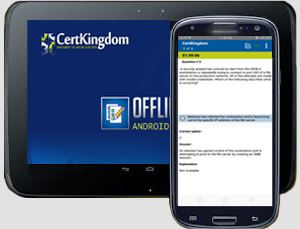
Take your learning mobile android device with all the features as desktop offline testing engine. All android devices are supported.
Supported Platforms: All Android OS EULA
Install the Android Testing Engine from google play store and download the app.ck from certkingdom website android testing engine download

Certkingdom Android Testing Engine Features
- CertKingdom Offline Android Testing Engine
- Make sure to enable Root check in Playstore
- Live Realistic practice tests
- Live Virtual test environment
- Live Practice test environment
- Mark unanswered Q&A
- Free Updates
- Save your tests results
- Re-examine the unanswered Q & A
- Make your own test scenario (settings)
- Just like the real tests: multiple choice questions
- Updated regularly, always current
