
Exam: 1Z0-1114-25

|
|||||||||||||||||||||||||||

Format: Multiple Choice
Duration: 90 Minutes
Number of Questions: 50
Passing Score: 68%
Validation: This Exam has been validated against Oracle Cloud Infrastructure
2025
Policy: Cloud Recertification
Earn associated certifications
Passing this exam is required to earn these certifications. Select each
certification title below to view full requirements.
Oracle Redwood Application 2025 Certified Developer Associate
The Oracle Redwood Application Developer Associate certification is designed
for individuals who craft user experiences for their clients using the Redwood
platform.
This certification validates the candidate's understanding of the Redwood
platform and Oracle Visual Builder Studio. This credential certifies the
candidate's knowledge and skills in designing and developing applications using
the Redwood Design System (RDS) and Redwood Development processes.
The 1Z0-1114-25 exam, Oracle Redwood Application 2025 Developer Associate, tests
skills in designing and developing applications with Oracle's Redwood platform
and Visual Builder Studio (VBS) for modern, user-friendly UIs, featuring 50
multiple-choice questions in 90 minutes, requiring a 68% to pass, covering VBS
configuration, Redwood components, Fusion app extensions, and CI/CD workflows
with Git.
Review exam topics
The Redwood Experience
Explain the need for a new applications platform
Explain the building blocks of the design system
Configuring Oracle Fusion Cloud Extensions with Visual Builder Studio
Explain the role of Oracle Visual Builder Studio (VBS) as a development
platform for Cloud Apps
Explain the types of supported extensions
Modify existing pages in Oracle SaaS using Visual Builder Studio
Create new Redwood page/app for SaaS data
Create new Redwood apps to mashup SaaS and external data
Developing Fusion Apps with Visual Builder Studio
Explain the features and components of Visual Builder Studio
Configure service connections in Visual Builder Studio
Use git, branches, and merge requests to manage code in Visual Builder Studio
Manage builds, jobs, pipelines, and deployments in Visual Builder Studio
Designing and Developing Redwood Applications
Identify Redwood patterns, templates, and components for product design and development
Use Redwood page templates and components to develop apps
Use Redwood Reference Application to explore specifications/demonstrations of the components
Design and develop applications using the Redwood System
1Z0-1114-25 Brain Dumps Exam + Online / Offline and Android Testing Engine & 4500+ other exams included
$50 - $25 (you save $25)
Buy Now
QUESTION 1
What does a build pipeline in Visual Builder Studio do?
A. Can only deploy an AppUI extension to a stand-alone VB instance
B. Can deploy an AppUI extension to only a single FA instance
C. Can only package an AppUI extension, which requires manual deployment
D. Can deploy an AppUI extension to multiple FA instances
Answer: D
Explanation:
Full Detailed in Depth Explanatio n:
A build pipeline in Visual Builder Studio (VBS) automates the process of
packaging, building, and
deploying applications or extensions, including AppUI extensions for Oracle
Fusion Applications (FA).
It is designed to streamline Continuous Integration/Continuous Deployment
(CI/CD) workflows.
Option D is correct because VBS build pipelines can deploy AppUI extensions to
multiple Fusion
Application instances (e.g., development, test, and production environments) as
configured in the
pipeline settings. This flexibility is a key feature of VBS, allowing developers
to target multiple
environments without manual intervention. Option A is incorrect because
deployment is not limited
to stand-alone VB instances; it can target FA instances as well. Option B is
wrong as it restricts
deployment to a single FA instance, which contradicts VBSs multi-environment
capability. Option C is
inaccurate because the pipeline does more than just packaging”it automates
deployment too.
Reference: Oracle Visual Builder Studio Documentation “ "Configuring Build
Pipelines"
QUESTION 2
Which three categories of developers use Visual Builder Studio as a
developmental tool? (Choose three.)
A. Developers creating stand-alone Visual Builder Apps
B. Developers extending Oracle Cloud Apps
C. Developers coding PL/SQL procedures in the Fusion database
D. Fusion Cloud Apps developers
Answer: A, B, D
Explanation:
Full Detailed in Depth Explanatio n:
Visual Builder Studio (VBS) is a development platform tailored for creating and
extending
applications, particularly within the Oracle ecosystem. Option A is correct
because VBS supports
building stand-alone Visual Builder applications hosted on Visual Builder
instances. Option B is
accurate as VBS is widely used to extend Oracle Cloud Applications (e.g., Fusion
Apps) via AppUI
extensions. Option D is correct because Fusion Cloud Apps developers leverage
VBS to customize and
enhance Fusion Apps UIs and functionality. Option C is incorrect because VBS
focuses on visual
development and REST-based integrations, not on coding PL/SQL procedures
directly in the Fusion
database, which is typically done using tools like SQL Developer or Application
Composer.
Reference: Oracle Visual Builder Studio Overview “ "Who Uses VBS"
QUESTION 3
You are planning to use the Dashboard Landing Page template for Key Performance
Indicators (KPIs),
and a dashboard grid with information visualizations that highlight and explain
business performance. Which is a required property of oj-sp-dashboard-landing-page?
A. Page Title
B. Page Subtitle
C. In Flow Back
D. Primary Action
Answer: A
Explanation:
Full Detailed in Depth Explanatio n:
The oj-sp-dashboard-landing-page is a Redwood component used to create
dashboard-style pages in
Oracle applications. According to the Redwood Pattern Book and component
documentation, the
Page Title (Option A) is a required property to define the dashboards identity
and purpose, ensuring
clarity for users. Options B (Page Subtitle), C (In Flow Back), and D (Primary
Action) are optional:
subtitles enhance context but arent mandatory, "In Flow Back" relates to
navigation flows (not
required), and primary actions are configurable but not essential for the
components basic functionality.
QUESTION 4
Dave deployed an AppUI extension to an instance by mistake. How can he fix this?
A. The extension will be removed in the next quarterly update of Fusion Cloud
Apps
B. The extension can be undeployed in the Visual Builder Studios Environment tab
C. The extension can be redeployed by opening a service request
D. The extension cannot be deleted once deployed
Answer: B
Explanation:
Full Detailed in Depth Explanatio n:
In Visual Builder Studio, if an AppUI extension is deployed to a Fusion Apps
instance by mistake, it
can be undeployed using the Environment tab in VBS. This tab allows developers
to manage
deployments, including removing or rolling back extensions from specific
instances (e.g., TEST or
PROD). Option A is incorrect because quarterly updates dont automatically remove
extensions”
theyre controlled by the developer. Option C is wrong as redeployment via a
service request isnt the
standard process; VBS provides self-service tools. Option D is false because VBS
supports
undeployment, making extensions reversible.
Reference: Oracle Visual Builder Studio Documentation “ "Managing Environments"
QUESTION 5
You are designing the UI to display information about a product and are
asked to use the card layout, such that:
The card layout summarizes the available information about a product in a
visually compact manner.
The card layout is used as an entry point from where users can access additional
details.
Which card layout is suitable for the above requirements?
A. Object Card
B. Mini Card
C. Image Card
D. Scoreboard
Answer: A
Explanation:
Full Detailed in Depth Explanatio n:
Redwood offers various card layouts, each with specific use cases. The Object
Card (Option A) is
designed to summarize key information about an entity (e.g., a product) in a
compact, visually
appealing way while serving as an entry point to detailed views”perfectly
matching the
requirements. Mini Card (B) is too minimal for summarization, focusing on quick
glances. Image Card
(C) prioritizes visuals over data summary, and Scoreboard (D) is for metrics/KPIs,
not product details.
Reference: Oracle Redwood Pattern Book “ "Card Layout Patterns"
Buy Complete
Certainly, here's a rewritten version of your text:
Packiam Vijendran 1 months ago - Malaysia
Passed the exam yesterday, 95% of the question were from this site. Note: Pay
more attention to all the community discussions on each question, instead of the
answers provided by the examtopics and I strongly suggest to get the contributor
access.
upvoted 4 times
Javier Cardaba Enjuto 2 months, 1 week ago - Spain
Excellent pre-exam session tool
upvoted 2 times
Palanisamy Arulmohan 1 months, 1 week ago - USA
I passed today, 94 questions asked and 99% of them were in this dump.
3 labs: BGP (as-override), HSRP, OSPF (without network statement)
upvoted 4 times
peppinauz 3 months, 2 weeks ago
I pass my exam, dump is valid about 90-95%. review the community answers!!
upvoted 6 times
Oberoi Ankit3 months, 3 weeks ago - USA Texas
Passed exam today dump still accurate. almost all the questions are here, some
are overcomplicated or incomplete on the site,
upvoted 4 times
logged members Can Post comments / review and take part in Discussion
Certkingdom Offline Testing Engine Simulator Download

Prepare with yourself how CertKingdom Offline Exam Simulator it is designed specifically for any exam preparation. It allows you to create, edit, and take practice tests in an environment very similar to an actual exam.
Supported Platforms: Windows-7 64bit or later - EULA | How to Install?
FAQ's: Windows-8 / Windows 10 if you face any issue kinldy uninstall and reinstall the Simulator again.
Download Offline Simulator-Beta
Certkingdom Testing Engine Features
- Certkingdom Testing Engine simulates the real exam environment.
- Interactive Testing Engine Included
- Live Web App Testing Engine
- Offline Downloadable Desktop App Testing Engine
- Testing Engine App for Android
- Testing Engine App for iPhone
- Testing Engine App for iPad
- Working with the Certkingdom Testing Engine is just like taking the real tests, except we also give you the correct answers.
- More importantly, we also give you detailed explanations to ensure you fully understand how and why the answers are correct.
Certkingdom Android Testing Engine Simulator Download
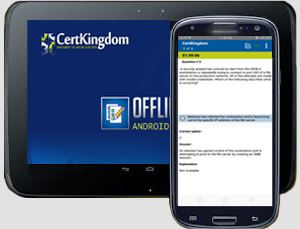
Take your learning mobile android device with all the features as desktop offline testing engine. All android devices are supported.
Supported Platforms: All Android OS EULA
Install the Android Testing Engine from google play store and download the app.ck from certkingdom website android testing engine download

Certkingdom Android Testing Engine Features
- CertKingdom Offline Android Testing Engine
- Make sure to enable Root check in Playstore
- Live Realistic practice tests
- Live Virtual test environment
- Live Practice test environment
- Mark unanswered Q&A
- Free Updates
- Save your tests results
- Re-examine the unanswered Q & A
- Make your own test scenario (settings)
- Just like the real tests: multiple choice questions
- Updated regularly, always current
