
Exam: OGEA-102

|
|||||||||||||||||||||||||||

The OGEA-102 is the official exam number for the TOGAF Enterprise
Architecture Part 2 Exam, which leads to the TOGAF Enterprise Architecture
Practitioner certification. It is a scenario-based test that assesses a
candidate's ability to apply the TOGAF Standard, 10th Edition, in real-world
situations.
Exam Format and Details
Exam Name: TOGAF Enterprise Architecture Part 2 Exam
Exam Number: OGEA-102 (English version) - (French) - (Simplified Chinese)
Prerequisites: You must pass the OGEA-101 (Part 1) exam first, or take both as
part of a combined exam (OGEA-103).
Question Format: 8 complex, scenario-based questions with gradient scoring.
The best answer scores 5 points, the second-best scores 3 points, the third-best
scores 1 point, and the distracter scores 0 points.
Time Limit: 90 minutes.
Pass Mark: 24 out of a maximum of 40 points (60%).
Open Book: Yes, this exam is open book.
Supervised: Yes, either at a test center or via online proctoring.
Key Topics Covered
The OGEA-102 exam assesses the practical application of TOGAF concepts.
Topics covered include Architecture Governance, the Architecture Development
Method (ADM) and its application across different phases, the Architecture
Repository, and the Architecture Capability Framework.
Registration and Preparation
Exam registration can be done through Pearson VUE. The Open Group suggests
authorized training and hands-on experience as preparation methods. Additional
details and official study materials are available on The Open Group's website.
The OGEA-102 exam (TOGAF Enterprise Architecture Part 2) focuses on the
practical application of the TOGAF framework in real-world scenarios
. The key topics are drawn from the Level 2 syllabus and cover the following
areas:
The Context for Enterprise Architecture: Understanding the environment in which
an Enterprise Architecture (EA) practitioner operates.
Stakeholder Management: Applying techniques to identify, analyze, and manage
stakeholder concerns and requirements effectively.
Architecture Development Method (ADM) Phases: Applying the various phases of the
ADM in detail, including:
Phase A (Architecture Vision): Scoping and defining the initial vision of the
architecture.
Phases B, C, and D (Business, Information Systems, and Technology
Architectures): Developing detailed architectures within these domains, using
relevant techniques and artifacts.
Phases E, F, and G (Opportunities & Solutions, Migration Planning, and
Implementation Governance): Planning the implementation, identifying work
packages, managing migration projects, and ensuring governance.
Preliminary Phase: Setting up the organizational context for the architecture
work.
Architecture Change Management: Managing ongoing changes to the architecture
through Phase H.
Requirements Management: The process of capturing, prioritizing, and managing
requirements throughout the entire ADM cycle.
Supporting the ADM Work: Utilizing essential TOGAF techniques and concepts, such
as:
Architecture Governance: Principles and practices for establishing and
maintaining an effective governance framework.
Architecture Repository: Understanding how to use the centralized repository for
architecture assets (catalogs, matrices, diagrams, the Standards Information
Base).
Architecture Capability Framework: Assessing and enhancing the organization's
ability to perform architecture work.
Business Transformation Readiness Assessment: Evaluating the organization's
preparedness for architectural changes.
Risk Management: Identifying and mitigating risks that arise during the
architecture implementation.
The exam questions are scenario-based, requiring candidates to demonstrate their
ability to apply these concepts and techniques to solve practical enterprise
architecture challenges. You can review the official syllabus and learning
outcomes on The Open Group's website.
OGEA-102 Brain Dumps Exam + Online / Offline and Android Testing Engine & 4500+ other exams included
$50 - $25 (you save $25)
Buy Now
QUESTION 1
Please read this scenario prior to answering the question
You are working as Chief Enterprise Architect at a large Internet company. The
company has many
divisions, ranging from cloud to logistics. The company has grown rapidly,
expanding from initially
selling physical books and media to a range of services including an online
marketplace, livestreaming. eBooks. and cloud services.
Overall management of the numerous divisions has become challenging. Recent
high-profile projects
have overrun on budget and under delivered, damaging the company's reputation,
and adversely
impacting its share price. There is a widely held view within the executive
management that the
organization structure has played a major role in these project failures.
The company has an established Enterprise Architecture program based on the
TOGAF standard,
sponsored jointly by the Chief Executive Officer (CEO) and Chief Information
Officer (CIO). The CEO
has decided that the company needs to reorganize its divisions around artificial
intelligence and
machine learning with a focus on automation. The CEO has worked with the
Enterprise Architects to
create a strategic architecture for the reorganization, including an
Architecture Vision, together with
definitions for the four domain architectures. This sets out an ambitious vision
of the future of the
company over a three-year period. This includes a set of work packages and
includes three distinct transformations.
The CIO has made it clear that prior to the approval of the detailed
Implementation and Migration
plan, the EAteam will need to assess the risks associated with the proposed
architecture. He has
received concerns from key stakeholders across the company that the proposed
reorganization may
be too ambitious and there is doubt whether it can produce sufficient value to
warrant the risks.
Refer to the scenario
You have been asked to recommend an approach to satisfy these concerns. Based on
the TOGAF
Standard, which of the following is the best answer?
A. The Enterprise Architects should evaluate the organization's readiness to
undergo change. This
will allow the risks associated with the transformations to be identified,
classified, and mitigated for.
This should include identifying dependencies between the set of changes,
including gaps and work
packages. It will also identify improvement actions to be worked into the
Implementation and
Migration Plan. The business value, effort, and risk associated for each
transformation should be determined.
B. The Enterprise Architects should bring together information about potential
approaches and
produce several alternative target transition architectures. They should then
investigate the different
architecture alternatives and discuss these with stakeholders using the
Architecture Alternatives and
Trade-offs technique. Once the target architecture has been selected, it should
be analyzed using a
state evolution table to determine the Transition Architectures. A value
realization process should
then be established to ensure that the concerns raised are addressed.
C. Establishing interoperability in alignment with the corporate operating model
will ensure risks are
minimized. The Enterprise Architects should apply an interoperability analysis
to evaluate any
potential issues across the architecture. This should include the development of
a matrix showing
the interoperability requirements. These can then be included within the
transformation strategy
embedded in the target transition architectures. The Enterprise Architects
should then finalize the
Architecture Roadmap and the Implementation and Migration Plan.
D. Before preparing the detailed Implementation and Migration plan, the
Enterprise
Architects should review and consolidate the gap analysis results from Phases B
to
This will identify the transformations required to achieve the proposed Target
Architecture. The Enterprise Architects should then assess the readiness of the
organization to undergo change and determine an overall direction to address and
mitigate risks identified. The Transition Architecture should then be planned to
use a
state evolution table.
Answer: A
Explanation:
The Business Transformation Readiness Assessment is a technique that can be used
to evaluate the
readiness of the organization to undergo change and to identify the actions
needed to increase the
likelihood of a successful business transformation. This technique can help to
address the concerns
of the key stakeholders about the risks and value of the proposed
reorganization. The technique
involves assessing the following aspects of the organization: vision,
commitment, capacity, capability,
culture, and communication. Based on the assessment, the risks associated with
the transformations
can be identified, classified, and mitigated for. The technique also helps to
identify the dependencies
between the set of changes, including gaps and work packages, and the
improvement actions to be
worked into the Implementation and Migration Plan. The technique also supports
the determination
of the business value, effort, and risk associated for each transformation,
which can be used to
prioritize and sequence the work packages and the Transition Architectures1
Reference: 1: The
TOGAF Standard, Version 9.2, Part III: ADM Guidelines and Techniques, Chapter
27: Business
Transformation Readiness Assessment
QUESTION 2
Please read this scenario prior to answering the question
Your role is that of a senior architect, reporting to the Chief Enterprise
Architect, at a medium-sized
company with 400 employees. The nature of the business is such that the data and
the information
stored on the company systems is their major asset and is highly confidential.
The company employees travel extensively for work and must communicate over
public
infrastructure using message encryption, VPNs, and other standard safeguards.
The company has
invested in cybersecurity awareness training for all its staff. However, it is
recognized that even with
good education as well as system security, there is a dependency on third-parly
suppliers of
infrastructure and software.
The company uses the TOGAF standard as the method and guiding framework for its
Enterprise
Architecture (EA) practice. The CTO is the sponsor of the activity.
The Chief Security Officer (CSO) has noted an increase in ransomware (malicious
software used in
ransom demands) attacks on companies with a similar profile. The CSO recognizes
that no matter
how much is spent on education, and support, it is likely just a matter of time
before the company
suffers a significant attack that could completely lock them out of their
information assets.
A risk assessment has been done and the company has sought cyber insurance that
includes
ransomware coverage. The quotation for this insurance is hugely expensive. The
CTO has recently
read a survey that stated that one in four organizations paying ransoms were
still unable to recover
their data, while nearly as many were able to recover the data without paying a
ransom. The CTO has
concluded that taking out cyber insurance in case they need to pay a ransom is
not an option.
Refer to the scenario
You have been asked to describe the steps you would take to improve the
resilience of the current architecture?
Based on the TOGAF standard which of the following is the best answer?
A. You would determine business continuity requirements, and undertake a gap
analysis of the
current Enterprise Architecture. You would make recommendations for change
requirements to
address the situation and create a change request. You would manage a meeting of
the Architecture
Board to assess and approve the change request. Once approved you would produce
a new Request
for Architecture Work to activate an ADM cycle to carry out a project to define
the change.
B. You would monitor for technology changes from your existing suppliers that
could improve
resilience. You would prepare and run a disaster recovery planning exercise for
a ransomware attack
and analyze the performance of the current Enterprise Architecture. Using the
findings, you would
prepare a gap analysis of the current Enterprise Architecture. You would prepare
change requests to
address identified gaps. You would add the changes implemented to the
Architecture Repository.
C. You would ensure that the company has in place up-to-date processes for
managing change to the
current Enterprise Architecture. Based on the scope of the concerns raised you
recommend that this
be managed at the infrastructure level. Changes should be made to the baseline
description of the
Technology Architecture. The changes should be approved by the Architecture
Board and
implemented by change management techniques.
D. You would request an Architecture Compliance Review with the scope to examine
the company's
resilience to ransomware attacks. You would identify the departments involved
and have them
nominate representatives. You would then tailor checklists to address the
requirement for increased
resilience. You would circulate to the nominated representatives for them to
complete. You would
then review the completed checklists, identifying and resolving issues. You
would then determine
and present your recommendations.
Answer: A
Explanation:
Business continuity is the ability of an organization to maintain essential
functions during and after a
disaster or disruption. Business continuity requirements are the specifications
and criteria that
define the acceptable level of performance and availability of the business
processes and services in
the event of a disaster or disruption. A gap analysis is a technique that
compares the current state of
the architecture with the desired state, and identifies the gaps or differences
that need to be
addressed. A change request is a formal proposal for an amendment to some
product or system,
such as the architecture. A Request for Architecture Work is a document that
describes the scope,
approach, and expected outcomes of an architecture project123
The best answer is A, because it describes the steps that would improve the
resilience of the current
architecture, which is the ability to withstand and recover from a ransomware
attack or any other
disruption. The steps are:
Determine the business continuity requirements, which specify the minimum
acceptable level of
performance and availability of the business processes and services in case of a
ransomware attack.
This would involve identifying the critical business functions, the recovery
time objectives, the
recovery point objectives, and the dependencies and resources needed for
recovery.
Undertake a gap analysis of the current Enterprise Architecture, which compares
the current state of
the architecture with the desired state based on the business continuity
requirements. This would
involve assessing the strengths and weaknesses of the current architecture, the
risks and
opportunities for improvement, and the gaps or differences that need to be
addressed.
Make recommendations for change requirements to address the situation and create
a change
request. This would involve proposing solutions and alternatives to close the
gaps, enhance the
resilience, and mitigate the risks of the current architecture. The change
request would document
the rationale, scope, impact, and benefits of the proposed changes, and seek
approval from the
relevant stakeholders.
Manage a meeting of the Architecture Board to assess and approve the change
request. The
Architecture Board is a governance body that oversees the architecture work and
ensures
compliance with the architecture principles, standards, and goals. The meeting
would involve
presenting the change request, discussing the pros and cons, resolving any
issues or conflicts, and
obtaining the approval or rejection of the change request.
Once approved, produce a new Request for Architecture Work to activate an ADM
cycle to carry out a
project to define the change. The Request for Architecture Work would describe
the scope, approach,
and expected outcomes of the architecture project that would implement the
approved change
request. The Request for Architecture Work would initiate a new cycle of the
Architecture
Development Method (ADM), which is the core process of the TOGAF standard that
guides the
development and management of the enterprise architecture.
Reference: 1: The TOGAF Standard, Version 9.2, Part III: ADM Guidelines and
Techniques, Chapter 33:
Business Scenarios 2: The TOGAF Standard, Version 9.2, Part III: ADM Guidelines
and Techniques,
Chapter 30: Gap Analysis 3: The TOGAF Standard, Version 9.2, Part III: ADM
Guidelines and
Techniques, Chapter 31: Architecture Change Management : The TOGAF Standard,
Version 9.2, Part
II: Architecture Development Method (ADM), Chapter 7: Request for Architecture
Work : The TOGAF
Standard, Version 9.2, Part III: ADM Guidelines and Techniques, Chapter 34:
Business Transformation
Readiness Assessment : The TOGAF Standard, Version 9.2, Part III: ADM Guidelines
and Techniques,
Chapter 30: Gap Analysis : The TOGAF Standard, Version 9.2, Part III: ADM
Guidelines and
Techniques, Chapter 31: Architecture Change Management : The TOGAF Standard,
Version 9.2, Part
VI: Architecture Capability Framework, Chapter 50: Architecture Governance : The
TOGAF Standard,
Version 9.2, Part II: Architecture Development Method (ADM), Chapter 7: Request
for Architecture Work
QUESTION 3
Please read this scenario prior to answering the question
You are serving as the Lead Architect for an Enterprise Architecture team within
a leading
multinational biotechnology company. The company works in three major
industries, including
healthcare, crop production, and agriculture. Your team works within the
healthcare division.
The healthcare division is developing a new vaccine, and has to demonstrate its
effectiveness and
safety in a set of clinical trials that satisfy the regulatory requirements of
the relevant health
authorities. The clinical trials are undertaken by its research laboratories at
multiple facilities
worldwide. In addition to internal research and development activities, the
healthcare division is
also involved in publicly funded collaborative research projects with industrial
and academic partners.
The Enterprise Architecture team has been engaged in an architecture project to
develop a secure
system that will allow the healthcare researchers to share information more
easily about their
clinical trials, and work more collaboratively across the organization and also
with its partners. This
system will also connect with external partners.
The Enterprise Architecture team uses the TOGAF ADM with extensions required to
support
healthcare manufacturing practices and laboratory practices. Due to the highly
sensitive nature of
the information that is managed, special care has been taken to ensure that each
architecture
domain considers the security and privacy issues that are relevant.
The Vice President for Worldwide Clinical Research is the sponsor of the
Enterprise Architecture
activity. She has stated that disruptions must be minimized for the clinical
trials, and that the rollout
must be undertaken incrementally.
Refer to the scenario
You have been asked to recommend the approach to identify the work packages for
an incremental
rollout meeting the requirements.
Based on the TOGAF standard which of the following is the best answer?
A. You recommend that the Solution Building Blocks from a Consolidated Gaps,
Solutions and
Dependencies Matrix be grouped into a set of work packages. Using the matrix as
a planning tool,
regroup the work packages to account for dependencies. Sequence the work
packages into the
Capability Increments needed to achieve the Target Architecture, so that the
implementation team
can schedule the rollout one region at a time to minimize disruption. Document
the work packages
for the Enterprise Architecture using a Transition Architecture State Evolution
Table.
B. You recommend that a Consolidated Gaps. Solutions and Dependencies Matrix is
used as a
planning tool for creating work packages. For each gap classify whether the
solution is either a new
development, purchased solution, or based on an existing product. Group the
similar solutions
together to define the work packages. Regroup the work packages into a set of
Capability Increments
to transition to the Target Architecture considering the schedule for clinical
trials, and document in
an Architecture Definition Increments Table.
C. You recommend that an Implementation Factor Catalog is drawn up to indicate
actions and
constraints. A Consolidated Gaps. Solutions and Dependencies Matrix should also
be created. For
each gap. identify a proposed solution and classify it as new development,
purchased solution, or
based on an existing product. Group similar activities together to form work
packages. Identify
dependencies between work packages factoring in the clinical trial schedules.
Regroup the work
packages into a set of Capability Increments scheduled into a series of
Transition Architectures.
D. You recommend that the set of required Solution Building Blocks be determined
by identifying
those which need to be developed and which need to be procured. Eliminate any
duplicates. Group
the remaining Solution Building Blocks together to create the work packages
using a CRUD (create,
read, update, delete) matrix. Rank the work packages and select the most
cost-effective options for
inclusion in a series of Transition Architectures. Schedule the roll out of the
work packages to be
sequential across the geographic regions.
Answer: B
Explanation:
A Consolidated Gaps, Solutions and Dependencies Matrix is a technique that can
be used to create
work packages for an incremental rollout of the architecture. A work package is
a set of actions or
tasks that are required to implement a specific part of the architecture. A work
package can be
associated with one or more Architecture Building Blocks (ABBs) or Solution
Building Blocks (SBBs),
which are reusable components of business, IT, or architectural capability. A
work package can also
be associated with one or more Capability Increments, which are defined,
discrete portions of the
overall capability that deliver business value. A Capability Increment can be
realized by one or more
Transition Architectures, which are intermediate states of the architecture that
enable the transition
from the Baseline Architecture to the Target Architecture123
The steps for creating work packages using this technique are:
For each gap between the Baseline Architecture and the Target Architecture,
identify a proposed
solution and classify it as new development, purchased solution, or based on an
existing product. A
gap is a difference or deficiency in the current state of the architecture that
needs to be addressed by
the future state of the architecture. A solution is a way of resolving a gap by
implementing one or
more ABBs or SBBs.
Group similar solutions together to define the work packages. Similar solutions
are those that have
common characteristics, such as functionality, technology, vendor, or location.
Identify dependencies between work packages, such as logical, temporal, or
resource dependencies.
Dependencies indicate the order or priority of the work packages, and the
constraints or risks that
may affect their implementation.
Regroup the work packages into a set of Capability Increments to transition to
the Target
Architecture. Capability Increments should be defined based on the business
value, effort, and risk
associated with each work package, and the schedule and objectives of the
clinical trials. Capability
Increments should also be aligned with the Architecture Vision and the
Architecture Principles.
Document the work packages and the Capability Increments in an Architecture
Definition Increments
Table, which shows the mapping between the work packages, the ABBs, the SBBs,
and the Capability
Increments. The table also shows the dependencies, assumptions, and issues
related to each work
package and Capability Increment.
Therefore, the best answer is B, because it describes the approach to identify
the work packages for
an incremental rollout meeting the requirements, using the Consolidated Gaps,
Solutions and
Dependencies Matrix as a planning tool.
Reference: 1: The TOGAF Standard, Version 9.2, Part III: ADM Guidelines and
Techniques, Chapter 30:
Gap Analysis 2: The TOGAF Standard, Version 9.2, Part IV: Architecture Content
Framework, Chapter
36: Building Blocks 3: The TOGAF Standard, Version 9.2, Part III: ADM Guidelines
and Techniques,
Chapter 31: Architecture Change Management : The TOGAF Standard, Version 9.2,
Part II:
Architecture Development Method (ADM), Chapter 23: Phase E: Opportunities and
Solutions : The
TOGAF Standard, Version 9.2, Part II: Architecture Development Method (ADM),
Chapter 21: Phase F:
Migration Planning : The TOGAF Standard, Version 9.2, Part II: Architecture
Development Method
(ADM), Chapter 18: Phase A: Architecture Vision : The TOGAF Standard, Version
9.2, Part III: ADM
Guidelines and Techniques, Chapter 23: Architecture Principles
QUESTION 4
Please read this scenario prior to answering the question
You have been appointed as senior architect working for an autonomous driving
technology
development company. The mission of the company is to build an industry leading
unified
technology and software platform to support connected cars and autonomous
driving.
The company uses the TOGAF Standard as the basis for its Enterprise Architecture
(EA) framework.
Architecture development within the company follows the purpose-based EA
Capability model as
described in the TOGAF Series Guide: A Practitioners'Approach to Developing
Enterprise Architecture
Following the TOGAF® ADM.
An architecture to support strategy has been completed defining a long-range
Target Architecture
with a roadmap spanning five years. This has identified the need for a portfolio
of projects over the
next two years. The portfolio includes development of travel assistance systems
using swarm data
from vehicles on the road.
The current phase of architecture development is focused on the Business
Architecture which needs
to support the core travel assistance services that the company plans to
provide. The core services
will manage and process the swarm data generated by vehicles, paving the way for
autonomous
driving in the future.
The presentation and access to different variations of data that the company
plans to offer through
its platform poses an architecture challenge. The application portfolio needs to
interact securely with
various third-party cloud services, and V2X (Vehicle-to-Everything) service
providers in many
countries to be able to manage the data at scale. The security of V2X is a key
concern for the
stakeholders. Regulators have stated that the user's privacy be always
protected, for example, so that
the drivers' journey cannot be tracked or reconstructed by compiling data sent
or received by the car.
Refer to the scenario
You have been asked to describe the risk and security considerations you would
include in the
current phase of the architecture development?
Based on the TOGAF standard which of the following is the best answer?
A. You will focus on the relationship with the third parties required for the
travel assistance systems
and define a trust framework. This will describe the relationship with each
party. Digital certificates
are a key part of the framework and will be used to create trust between
parties. You will monitor
legal and regulatory changes across all the countries to keep the trust
framework in compliance.
B. You will perform a qualitative risk assessment for the data assets exchanged
with partners. This
will deliver a set of priorities, high to medium to low, based on identified
threats, the likelihood of
occurrence, and the impact if it did occur. Using the priorities, you would then
develop a Business
Risk Model which will detail the risk strategy including classifications to
determine what mitigation is enough.
C. You will focus on data quality as it is a key factor in risk management. You
will identify the datasets
that need to be safeguarded. For each dataset, you will assign ownership and
responsibility for the
quality of data needs. A security classification will be defined and applied to
each dataset. The
dataset owner will then be able to authorize processes that are trusted for a
certain activity on the
dataset under certain circumstances.
D. You will create a security domain model so that assets with the same level
can be managed under
one security policy. Since data is being shared across partners, you will
establish a security federation
to include them. This would include contractual arrangements, and a definition
of the responsibility
areas for the data exchanged, as well as security implications. You would
undertake a risk assessment
determining risks relevant to specific data assets.
Answer: D
Explanation:
A security domain model is a technique that can be used to define the security
requirements and
policies for the architecture. A security domain is a grouping of assets that
share a common level of
security and trust. A security policy is a set of rules and procedures that
govern the access and
protection of the assets within a security domain. A security domain model can
help to identify the
security domains, the assets within each domain, the security policies for each
domain, and the
relationships and dependencies between the domains1
Since the data is being shared across partners, a security federation is needed
to establish a trust
relationship and a common security framework among the different parties. A
security federation is
a collection of security domains that have agreed to interoperate under a set of
shared security
policies and standards. A security federation can enable secure data exchange
and collaboration
across organizational boundaries, while preserving the autonomy and privacy of
each party. A
security federation requires contractual arrangements, and a definition of the
responsibility areas for
the data exchanged, as well as security implications2
A risk assessment is a process that identifies, analyzes, and evaluates the
risks that may affect the
architecture. A risk assessment can help to determine the likelihood and impact
of the threats and
vulnerabilities that may compromise the security and privacy of the data assets.
A risk assessment
can also help to prioritize and mitigate the risks, and to monitor and review
the risk situation3
Therefore, the best answer is D, because it describes the risk and security
considerations that would
be included in the current phase of the architecture development, which is
focused on the Business
Architecture. The answer covers the security domain model, the security
federation, and the risk
assessment techniques that are relevant to the scenario.
Reference: 1: The TOGAF Standard, Version 9.2, Part III: ADM Guidelines and
Techniques, Chapter 35:
Security Architecture and the ADM 2: The TOGAF Standard, Version 9.2, Part IV:
Architecture Content
Framework, Chapter 38: Security Architecture 3: The TOGAF Standard, Version 9.2,
Part III: ADM
Guidelines and Techniques, Chapter 32: Risk Management
QUESTION 5
Please read this scenario prior to answering the question
You are the Lead Enterprise Architect at a major agribusiness company. The
company's main harvest
is lentils, a highly valued food grown worldwide. The lentil parasite,
broomrape, has been an
increasing concern for many years and is now becoming resistant to chemical
controls. In addition,
changes in climate favor the propagation and growth of the parasite. As a
result, the parasite cannot
realistically be exterminated, and it has become pandemic, with lentil yields
falling globally.
In response to the situation, the CEO has decided that the lentil fields will be
used for another
harvest. The company will also cease to process third-party lentils and will
repurpose its processing
plants. Thus, the target market will change, and the end-products will be
different and more varied.
The company has recently established an Enterprise Architecture practice based
on the TOGAF
standard as method and guiding framework. The CIO is the sponsor of the
activity. A formal request
for architecture change has been approved. At this stage there is no fixed
scope, shared vision, orobjectives.
Refer to the scenario
You have been asked to propose the best approach for architecture development to
realize the CEO's
change in direction for the company.
Based on the TOGAF standard which of the following is the best answer?
A. You propose that this engagement define the baseline Technology Architecture
first in order to
assess the current infrastructure capacity and capability for the company. Then
the focus should be
on transition planning and incremental architecture deployment. This will
identify requirements to
ensure that the projects are sequenced in an optimal fashion so as to realize
the change.
B. You propose that the team uses the architecture definition document and focus
on architecture
development starting simultaneously phases B, C and D. This is because the CEO
has identified the
need to change. This will ensure that the change can be defined in a structured
manner and address
the requirements needed to realize the change.
C. You propose that the team focus on architecture definition including
development of business
models, with emphasis on defining the change parameters to support this new
business strategy that
the CEO has identified. Once understood, the team will be in the best position
to identify the
requirements, drivers, issues, and constraints for the change.
D. You propose that the priority is to produce a new Request for Architecture
Work leading to
development of a new Architecture Vision. The trade-off method should be applied
to identify and
select an architecture satisfying the stakeholders. For an efficient change the
EA team should be
aligned with the organization's planning, budgeting, operational, and change
processes.
Answer: D
Explanation:
A Request for Architecture Work is a document that describes the scope,
approach, and expected
outcomes of an architecture project. A Request for Architecture Work is usually
initiated by the
sponsor or client of the architecture work, and approved by the Architecture
Board, which is a
governance body that oversees the architecture work and ensures compliance with
the architecture
principles, standards, and goals. A Request for Architecture Work triggers a new
cycle of the
Architecture Development Method (ADM), which is the core process of the TOGAF
standard that
guides the development and management of the enterprise architecture12
An Architecture Vision is a high-level description of the desired outcomes and
benefits of the
proposed architecture. An Architecture Vision is the output of Phase A:
Architecture Vision of the
ADM cycle, which is the first phase of the architecture development. An
Architecture Vision defines
Buy Complete
Students Feedback / Reviews/ Discussion
Mahrous Mostafa Adel Amin 1 week, 2 days ago - Abuhib- United Arab
Emirates
Passed the exam today, Got 98 questions in total, and 2 of them weren’t from
exam topics. Rest of them was exactly the same!
upvoted 4 times
Mbongiseni Dlongolo - South Africa2 weeks, 5 days ago
Thank you so much, I passed OGEA-102 today! 41 questions out of 44 are from
Certkingdom
upvoted 2 times
Kenyon Stefanie 1 month, 1 week ago - USA State / Province = Virginia
Thank you so much, huge help! I passed OGEA-102 Huawei today! The big majority
of questions were from here.
upvoted 2 times
Danny 1 month, 1 week ago - United States CUSTOMER_STATE_NAME: Costa Mesa =
USA
Passed the exam today, 100% points. Got 44 questions in total, and 3 of them
weren’t from exam topics. Rest of them was exactly the same!
MENESES RAUL 93% 2 week ago - USA = Texas
was from this topic! I did buy the contributor access. Thank you certkingdom!
upvoted 4 times
Zemljaric Rok 1 month, 2 weeks ago - Ljubljana Slovenia
Cleared my exam today - Over 80% questions from here, many thanks certkingdom
and everyone for the meaningful discussions.
upvoted 2 times
logged members Can Post comments / review and take part in Discussion
Certkingdom Offline Testing Engine Simulator Download

Prepare with yourself how CertKingdom Offline Exam Simulator it is designed specifically for any exam preparation. It allows you to create, edit, and take practice tests in an environment very similar to an actual exam.
Supported Platforms: Windows-7 64bit or later - EULA | How to Install?
FAQ's: Windows-8 / Windows 10 if you face any issue kinldy uninstall and reinstall the Simulator again.
Download Offline Simulator-Beta
Certkingdom Testing Engine Features
- Certkingdom Testing Engine simulates the real exam environment.
- Interactive Testing Engine Included
- Live Web App Testing Engine
- Offline Downloadable Desktop App Testing Engine
- Testing Engine App for Android
- Testing Engine App for iPhone
- Testing Engine App for iPad
- Working with the Certkingdom Testing Engine is just like taking the real tests, except we also give you the correct answers.
- More importantly, we also give you detailed explanations to ensure you fully understand how and why the answers are correct.
Certkingdom Android Testing Engine Simulator Download
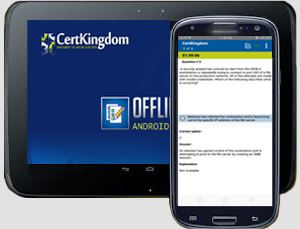
Take your learning mobile android device with all the features as desktop offline testing engine. All android devices are supported.
Supported Platforms: All Android OS EULA
Install the Android Testing Engine from google play store and download the app.ck from certkingdom website android testing engine download

Certkingdom Android Testing Engine Features
- CertKingdom Offline Android Testing Engine
- Make sure to enable Root check in Playstore
- Live Realistic practice tests
- Live Virtual test environment
- Live Practice test environment
- Mark unanswered Q&A
- Free Updates
- Save your tests results
- Re-examine the unanswered Q & A
- Make your own test scenario (settings)
- Just like the real tests: multiple choice questions
- Updated regularly, always current
