
Exam: H19-308_V4.0

|
|||||||||||||||||||||||||||

The H19-308_V4.0 (HCSA-Presales-Storage V4.0) is a certification exam from
Huawei designed for presales engineers who manage storage products and
solutions.
Exam Key Details
Certification Name: HCSA-Presales-Storage V4.0.
Exam Code: H19-308_V4.0 (English version).
Exam Duration: Typically 90 minutes.
Question Formats: Multiple-choice (single and multiple response), True/False,
and occasionally drag-and-drop or simulation questions.
Testing Partner: Exams are usually administered through Pearson VUE.
Core Knowledge Domains
The exam evaluates your ability to understand and design Huawei storage
solutions, covering the following areas:
Storage Foundations: SAN storage, NAS storage, and object storage architectures.
Huawei Main Products: Features of OceanStor Dorado all-flash storage, OceanStor
hybrid flash, and OceanStor Pacific scale-out storage.
Data Protection: Backup and disaster recovery solutions, specifically using
OceanProtect backup storage.
Networking Basics: TCP/IP architecture, IP addressing, subnetting, and protocol
interaction (ICMP).
Presales Services: Pricing, compliance, security, and privacy concepts related
to storage services.
Exam Preparation Resources
Official Training: Access learning materials on the Huawei Talent Online
platform.
Mock Exams: You can find sample questions and flashcards on platforms like
Quizlet.
Practice Questions: Third-party providers like Testpassport and DumpsPedia
provide updated 2026 practice questions and exam dumps.
The primary exam topics include:
1. Storage Fundamentals
Disk and Data Protection: Core concepts of HDDs vs. SSDs and data protection
mechanisms like RAID (e.g., RAID 10 disk requirements).
Storage Types: Identifying differences between SAN, NAS, and Object storage
architectures.
2. SAN and NAS Technologies
SAN Storage: Understanding networking, protocols (FC, iSCSI), and primary
SAN technologies.
NAS Storage: Knowledge of file system protocols (NFS, SMB), sharing between
different OS environments, and NAS-specific features.
Protocols: Support for Active Directory and LDAP in domain controller systems.
3. Object Storage and Data Management
Object Storage Features: Protocol support and direct access methods for
object-based storage.
Storage Efficiency: Implementing Thin Provisioning, QoS (Flow Control), and
Storage Tiering.
Intelligent Caching: Use of Level-2 (SSD) cache to enhance system performance.
4. Backup and Disaster Recovery (DR)
Core Concepts: Understanding backup networking modes and DR protection layers
(Storage, Network, Host layers).
Replication: Differences between synchronous and asynchronous replication, and
the role of quorum servers in Active-Active modes.
5. Huawei Storage Product Solutions
Product Identification: Matching customer requirements to specific Huawei
solutions like the OceanStor Dorado series.
OceanStor Dorado Features: Understanding its all-flash architecture, convergence
capabilities, and high-performance Active-Active (gateway-free) modes.
Presales Strategy: Identifying key competitive advantages and solution scenarios
for Huawei storage products.
For official study resources and scheduling, you can visit the Huawei Talent Portal.
H19-308_V4.0 Brain Dumps Exam + Online / Offline and Android Testing Engine & 4500+ other exams included
$50 - $25 (you save $25)
Buy Now
QUESTION 1
Compared with HDDs, SSDs have high I/O performance and low latency.
A. TRUE
B. FALSE
Answer: A
Explanation:
According to Huaweis technical documentation on storage media, Solid State
Drives (SSDs)
fundamentally differ from Hard Disk Drives (HDDs) in their physical construction
and data access
methods. HDDs rely on mechanical components, including rotating platters and
moving read/write
heads. This mechanical nature introduces "rotational latency" and "seek time,"
which inherently limit
the number of Input/Output Operations Per Second (IOPS).
In contrast, Huaweis OceanStor SSDs utilize flash memory chips (NAND Flash) and
a highperformance
controller. Because there are no moving parts, the "seek time" is eliminated,
allowing
for near-instantaneous data access. This results in significantly higher random
IOPS and much lower
latency (often measured in microseconds rather than milliseconds). Furthermore,
Huaweis
FlashLink® technology further optimizes the collaboration between the storage
controller and the
SSDs, ensuring that even as the drive fills up, the performance remains
consistent and the latency
remains low. Therefore, in any performance-oriented storage environment, SSDs
are the preferred
choice over traditional HDDs.
QUESTION 2
Which RAID level cannot provide data redundancy protection?
A. RAID 5
B. RAID 6
C. RAID 1
D. RAID 0
Answer: D
Explanation:
In the Huawei OceanStor RAID 2.0+ architecture, Redundant Array of Independent
Disks (RAID) levels
are used to balance performance, capacity, and reliability. RAID 0, also known
as "striping,"
distributes data blocks across multiple physical disks to maximize I/O
performance. By allowing
multiple disks to be read or written simultaneously, it provides the highest
throughput and capacity utilization (100%).
However, the defining characteristic of RAID 0 is the complete lack of
redundancy. Unlike RAID 1
(Mirroring), RAID 5 (Parity), or RAID 6 (Dual Parity), RAID 0 does not store
redundant information or
parity bits. Huawei documentation explicitly states that if any single physical
disk in a RAID 0 group
fails, the entire RAID group becomes inaccessible, and all data within that
group is lost. Therefore,
RAID 0 is strictly recommended only for temporary data or scenarios where data
loss is acceptable
and maximum performance is the sole priority. For enterprise production
environments, Huawei
recommends RAID 5, RAID 6, or RAID-TP.
QUESTION 3
What are the main application scenarios for SAN storage? (Select all that apply)
A. Big data storage
B. VMware virtualization
C. Database
D. Mass file sharing
Answer: B, C
Explanation:
Storage Area Network (SAN) storage is designed to provide block-level data
access to servers,
appearing to the operating system as a locally attached hard drive. Huawei
OceanStor SAN solutions
(both FC-SAN and IP-SAN) are optimized for high-performance, low-latency
applications.
Databases (Option C), such as Oracle, SQL Server, and DB2, are primary use cases
for SAN storage
because they require high IOPS and low latency for transactional processing. The
block-level access
allows the database management system to have granular control over data
placement and caching.
VMware virtualization (Option B) is another core scenario. SANs provide the
shared storage
necessary for advanced features like VMotion, High Availability (HA), and
Distributed Resource
Scheduler (DRS). In these environments, multiple ESXi hosts connect to a
centralized SAN to access
VMFS (Virtual Machine File System) volumes. While Option A (Big Data) and Option
D (File Sharing)
often use Distributed Storage (OceanStor Pacific) or NAS, the high-concurrency,
structured nature of
Databases and Virtualization makes them the definitive scenarios for SAN.
QUESTION 4
RAID 0 is actually a mirroring technology.
A. TRUE
B. FALSE
Answer: B
Explanation:
This statement is false because RAID 0 and Mirroring (RAID 1) are fundamentally
different concepts
in Huawei storage technology. As defined in the Huawei technical manual, RAID 0
is "Striping." It
breaks data into chunks and spreads them across multiple disks to increase
performance. It has no redundancy.
"Mirroring" is the terminology specifically used for RAID 1. In a RAID 1
configuration, the system
writes the exact same data to two separate physical disks simultaneously. This
creates a 100%
redundant copy (a mirror). If one disk fails, the other continues to provide
data, ensuring zero
downtime and no data loss. Huawei's RAID 2.0+ virtualization technology can
implement striping and
mirroring across different "chunks" or "extents" within a storage pool, but it
maintains the technical
distinction: RAID 0 is for performance through striping, while mirroring is for
reliability through
duplication. Therefore, characterizing RAID 0 as a mirroring technology is a
technical inaccuracy.
QUESTION 5
Which statements are correct about NVMe over Fabrics (NVMe-oF) (RoCE v2)?
(Select all that apply)
A. Traditional Ethernet can transmit NVMe-oF (RoCE v2) data packets without
packet loss.
B. NVMe-oF (RoCE v2) significantly improves performance by using Remote Direct
Memory Access (RDMA).
C. Lossless Ethernet can transmit NVMe-oF (RoCE v2) data packets.
D. The cost of NVMe-oF (RoCE v2) is generally higher than that of NVMe-oF (Fibre
Channel).
Answer: B, C
Explanation:
NVMe over Fabrics (NVMe-oF) using the RoCE v2 (RDMA over Converged Ethernet)
protocol is a
high-speed communication technology supported by Huawei OceanStor Dorado
systems. Option B is
correct because RoCE v2 utilizes RDMA, which allows data to be transferred
directly from the
memory of one computer to another without involving the CPU of either system.
This significantly
reduces latency and CPU overhead compared to traditional iSCSI.
Option C is correct because RoCE v2 requires a "Lossless Ethernet" environment
to function correctly.
Traditional Ethernet (Option A) is a "best-effort" delivery system that allows
for packet drops during
congestion; however, RDMA protocols are highly sensitive to packet loss. To
support RoCE v2, the
network must implement Data Center Bridging (DCB) features like Priority Flow
Control (PFC) and
Enhanced Transmission Selection (ETS) to ensure a zero-packet-loss environment.
Regarding cost
(Option D), RoCE v2 often leverages existing Ethernet infrastructure, making it
generally more costeffective
than deploying a dedicated Fibre Channel (FC) fabric, which requires specialized
HBAs and FC switches.
Buy Complete
Students Feedback / Reviews/ Discussion
Mahrous Mostafa Adel Amin 1 week, 2 days ago - Abuhib- United Arab
Emirates
Passed the exam today, Got 98 questions in total, and 2 of them weren’t from
exam topics. Rest of them was exactly the same!
upvoted 4 times
Mbongiseni Dlongolo - South Africa2 weeks, 5 days ago
Thank you so much, I passed H19-308_V4.0 today! 41 questions out of 44 are from
Certkingdom
upvoted 2 times
Kenyon Stefanie 1 month, 1 week ago - USA State / Province = Virginia
Thank you so much, huge help! I passed H19-308_V4.0 Huawei today! The big majority
of questions were from here.
upvoted 2 times
Danny 1 month, 1 week ago - United States CUSTOMER_STATE_NAME: Costa Mesa =
USA
Passed the exam today, 100% points. Got 44 questions in total, and 3 of them
weren’t from exam topics. Rest of them was exactly the same!
MENESES RAUL 93% 2 week ago - USA = Texas
was from this topic! I did buy the contributor access. Thank you certkingdom!
upvoted 4 times
Zemljaric Rok 1 month, 2 weeks ago - Ljubljana Slovenia
Cleared my exam today - Over 80% questions from here, many thanks certkingdom
and everyone for the meaningful discussions.
upvoted 2 times
logged members Can Post comments / review and take part in Discussion
Certkingdom Offline Testing Engine Simulator Download

Prepare with yourself how CertKingdom Offline Exam Simulator it is designed specifically for any exam preparation. It allows you to create, edit, and take practice tests in an environment very similar to an actual exam.
Supported Platforms: Windows-7 64bit or later - EULA | How to Install?
FAQ's: Windows-8 / Windows 10 if you face any issue kinldy uninstall and reinstall the Simulator again.
Download Offline Simulator-Beta
Certkingdom Testing Engine Features
- Certkingdom Testing Engine simulates the real exam environment.
- Interactive Testing Engine Included
- Live Web App Testing Engine
- Offline Downloadable Desktop App Testing Engine
- Testing Engine App for Android
- Testing Engine App for iPhone
- Testing Engine App for iPad
- Working with the Certkingdom Testing Engine is just like taking the real tests, except we also give you the correct answers.
- More importantly, we also give you detailed explanations to ensure you fully understand how and why the answers are correct.
Certkingdom Android Testing Engine Simulator Download
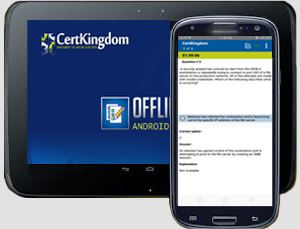
Take your learning mobile android device with all the features as desktop offline testing engine. All android devices are supported.
Supported Platforms: All Android OS EULA
Install the Android Testing Engine from google play store and download the app.ck from certkingdom website android testing engine download

Certkingdom Android Testing Engine Features
- CertKingdom Offline Android Testing Engine
- Make sure to enable Root check in Playstore
- Live Realistic practice tests
- Live Virtual test environment
- Live Practice test environment
- Mark unanswered Q&A
- Free Updates
- Save your tests results
- Re-examine the unanswered Q & A
- Make your own test scenario (settings)
- Just like the real tests: multiple choice questions
- Updated regularly, always current
