
Exam: H13-511_V5.5

|
|||||||||||||||||||||||||||

Key Details:
Certification: HCIA-Cloud Computing (Huawei Certified ICT Associate).
Exam Code: H13-511_V5.5-ENU (English).
Topics: Cloud Fundamentals, Virtualization (FusionCompute), Storage, Network
Virtualization, Virtual Desktops (FusionAccess).
Format: Multiple-Choice, True/False, Drag-and-Drop, Short Answer.
Duration: 90 minutes.
Scoring: 600 points to pass (out of 1000).
Language: English (ENU).
Key Subject Areas
The exam covers four primary modules focused on enterprise-level cloud
infrastructure:
Cloud Computing Fundamentals: Basic concepts, IT development trends, and
server/storage/network/OS basics.
Virtualization (FusionCompute): Deep dive into the Huawei virtualization
platform, including compute, storage, and network virtualization management.
Desktop Cloud (FusionAccess): Planning, deployment, service provisioning, and
feature management for virtual desktop solutions.
Emerging Trends: Overview of OpenStack and newer cloud technologies.
Preparation Resources
Official Training: Candidates can access learning materials through the
Huawei Talent Online portal.
Practice Tests: Various providers offer practice questions updated for the V5.5
version as of early 2026.
Hands-on Experience: Practical familiarity with Huawei's FusionCompute and
FusionAccess platforms is highly recommended for passing.
The H13-511_V5.5 (HCIA-Cloud Computing V5.5) exam for 2026 focuses on four
primary knowledge modules, with heavy emphasis on Huawei’s proprietary
virtualization and desktop cloud platforms.
1. Cloud Computing Basics (26%)
This section covers general IT foundations required for cloud
infrastructure:
Cloud Fundamentals: Concepts, service models (IaaS, PaaS, SaaS), and deployment
models.
Hardware & OS: Server architecture, storage technology basics (FC SAN, IP SAN,
NAS), and network basics (IP, VLAN, Routing/Switching).
Operating Systems: Introduction to OS and basic operations, specifically focused
on openEuler for Linux environments.
2. Virtualization (FusionCompute) (35%)
This module is the core of the exam and tests management of the Huawei
FusionCompute platform:
Compute Virtualization: Managing VMs, CPU/memory resources (including memory
overcommitment like sharing and ballooning), and NUMA.
Storage Virtualization: VIMS file system features, thin provisioning, and
snapshots.
Network Virtualization: Distributed Virtual Switches (DVS), port groups, and
uplink management.
Advanced Features: High Availability (HA), Intelligent Resource Scheduling
(DRS), and VM live migration (including IMC policy for different CPU models).
3. Desktop Cloud (FusionAccess) (35%)
Focuses on virtual desktop infrastructure (VDI) deployment and service
provisioning:
Architecture & Components: Roles of WI (Web Interface), ITA, vAG (Access
Gateway), and vLB (Load Balancer).
Huawei Desktop Protocol (HDP): Bitmap classification and compression algorithms
for different data types (text vs. graphics).
Service Provisioning: Creating desktop templates, linked clone provisioning, and
domain management.
Operations & Maintenance: Policy management (USB/audio redirection) and
troubleshooting desktop connectivity.
4. Cloud Computing Trends (4%)
A high-level overview of modern cloud evolutions:
Open Source: Brief introduction to OpenStack and KVM.
Cloud-Native: Containers (Docker), orchestration (Kubernetes), and microservices.
Emerging Tech: Trends in Big Data, AI, and Hybrid Cloud.
H13-511_V5.5 Brain Dumps Exam + Online / Offline and Android Testing Engine & 4500+ other exams included
$50 - $25 (you save $25)
Buy Now
QUESTION 1
A small Internet company decides to deploy its services on Huawei Cloud
during the early stages of development. Which of the following is NOT an
advantage of deploying services on Huawei Cloud?
A. Quick service deployment and rollout
B. Flexible resource scaling
C. Higher hardware performance with the same configuration
D. Reduced hardware costs
Answer: C
Explanation:
Comprehensive and Detailed Explanation (HCIA“Cloud Computing aligned):
From the HCIA“Cloud Computing learning scope, the core advantages of using cloud
services
(including Huawei Cloud) are typically tied to agility, elasticity, and cost
efficiency.
Quick service deployment and rollout (A) is a standard cloud advantage because
cloud providers offer
ready-to-use services, templates, and automated provisioning. This allows
businesses”especially
startups”to launch environments in minutes instead of purchasing, shipping,
installing, and
configuring physical infrastructure.
Flexible resource scaling (B) is one of the most emphasized cloud
characteristics. Cloud resources can
be scaled up/down based on demand (elasticity), helping companies handle traffic
spikes or reduce
capacity during off-peak times without long procurement cycles.
Reduced hardware costs (D) is also a common advantage because the company avoids
large upfront
capital expenses (CapEx) for servers, storage, and networking. Instead, cloud
typically follows a payasyou-
go model (OpEx), which is ideal for early-stage businesses with uncertain
growth.
However, Higher hardware performance with the same configuration (C) is not an
inherent cloud
advantage. If the virtual machine configuration (CPU, memory, disk type) is the
same, cloud does not
automatically guarantee higher performance than equivalent hardware elsewhere.
Performance
depends on factors such as underlying physical host load, storage type, network
conditions, and
service class”so oehigher performance with the same configuration is not a
guaranteed benefit and
therefore is the incorrect oeadvantage.
Important note (transparency): I can format and answer based on HCIA domain
concepts, but I
cannot provide oeexact extracts from Huawei official copyrighted documents in a
verbatim way.
QUESTION 2
Which of the following statements is false about the development of cloud
computing architecture?
A. In terms of cloud platforms and cloud management software, it has evolved
from closed-source and closed architecture to open-source and open architecture.
B. It has evolved from non-critical IT applications to critical enterprise
applications.
C. It has evolved from unstructured or semi-structured data to structured data.
D. It has evolved from small-scale resource virtualization and integration to
large-scale resource pool construction.
Answer: C
Explanation:
Comprehensive and Detailed Explanation (HCIA“Cloud Computing aligned):
According to the HCIA“Cloud Computing curriculum, the evolution of cloud
computing architecture
reflects changes in technology openness, business importance, resource scale,
and data characteristics.
Option A is correct because early cloud platforms were often proprietary and
closed, while modern
cloud computing architectures increasingly adopt open-source technologies (such
as OpenStack and
Kubernetes) and open architectures to improve interoperability and innovation.
Option B is also correct. Cloud computing initially hosted non-critical
workloads such as testing,
development, and backup systems. As reliability, security, and availability
improved, cloud platforms
became capable of supporting mission-critical enterprise applications, including
ERP, financial
systems, and core business services.
Option D correctly describes the evolution of cloud architecture. Early
virtualization focused on
small-scale resource integration, while modern cloud computing emphasizes
large-scale resource
pools, enabling centralized management, elastic scheduling, and efficient
utilization of massive
compute, storage, and network resources.
Option C is false. The evolution of cloud computing data has moved from
structured data to semistructured
and unstructured data, not the other way around. With the rise of big data, IoT,
social
media, logs, images, and videos, cloud platforms are increasingly designed to
process massive
volumes of unstructured and semi-structured data, which is a key trend
emphasized in HCIA learning materials.
QUESTION 3
The service modes for cloud computing include Infrastructure as a Service (IaaS),
Platform as a
Service (PaaS), and Software as a Service (SaaS). Which of the following
statements are false about the IaaS model?
A. Users need to install a virtualization suite to integrate resources.
B. Users only need to pay attention to applications.
C. Users only need to focus on applications and data.
D. Users only need to focus on systems and applications.
Answer: A, B, C
Explanation:
Comprehensive and Detailed Explanation (HCIA“Cloud Computing aligned):
The HCIA“Cloud Computing syllabus clearly defines responsibility boundaries for
IaaS. In the IaaS
model, the cloud provider delivers basic infrastructure resources, including
compute, storage,
networking, and virtualization. The user is responsible for managing operating
systems, middleware,
runtime environments, applications, and data.
Option A is false because virtualization is managed by the cloud provider, not
the user. In IaaS, users
consume virtualized resources (such as ECS instances) but do not deploy or
maintain the underlying
hypervisors or virtualization platforms.
Option B is false. Only focusing on applications aligns with the SaaS model,
where the provider
manages everything else. In IaaS, users must also manage operating systems and
system-level
configurations.
Option C is also false. Focusing only on applications and data corresponds more
closely to PaaS,
where the platform handles operating systems and runtime environments.
Option D is the correct description of IaaS responsibilities, because users must
manage operating
systems (systems) and applications, while the provider manages the
infrastructure layer. Therefore, D
is not false and is excluded from the answer.
QUESTION 4
The Central Processing Unit (CPU) is the computer's computing and control
core. Mainly composed
of an arithmetic logic unit (ALU) and a controller, it reads and executes data
according to instructions.
A. TRUE
B. FALSE
Answer: A
Explanation:
Comprehensive and Detailed Explanation (HCIA“Cloud Computing aligned):
According to the HCIA“Cloud Computing curriculum under Server Basics, the CPU is
defined as the
core component responsible for computation and control within a computer system.
The CPU
executes program instructions and coordinates the operation of all other
hardware components.
The CPU is primarily composed of two main functional units:
Arithmetic Logic Unit (ALU): Responsible for performing arithmetic operations
(such as addition and
subtraction) and logical operations (such as comparisons and logical AND/OR).
Control Unit (Controller): Responsible for fetching instructions from memory,
decoding them, and
controlling the execution process by issuing control signals to other
components.
The CPU operates based on the fetch“decode“execute cycle, which is a fundamental
concept
emphasized in HCIA learning materials. During this process, the CPU reads
instructions and related
data from memory, processes them, and produces results according to the
instruction set
architecture.
Because the statement accurately describes the role, composition, and working
principle of the CPU
as defined in Huaweis HCIA“Cloud Computing documentation, it is correct.
QUESTION 5
Which of the following statements is false about Redundant Array of Independent
Disks (RAID)?
A. RAID 0 uses striping to improve data read and write performance.
B. RAID 6 uses mirroring to ensure user data reliability.
C. RAID 1 uses mirroring to ensure user data reliability.
D. RAID 5 uses parity check to ensure data reliability.
Answer: B
Explanation:
Comprehensive and Detailed Explanation (HCIA“Cloud Computing aligned):
RAID technology is a key topic in the Storage Technology Basics domain of
HCIA“Cloud Computing.
Different RAID levels provide varying balances of performance, capacity, and
fault tolerance.
RAID 0 (A) uses data striping across multiple disks to improve read/write
performance but provides
no data redundancy. This statement is correct.
RAID 1 (C) uses disk mirroring, where identical data is written to two disks,
ensuring high data reliability. This statement is correct.
RAID 5 (D) uses distributed parity across disks, allowing data recovery if one
disk fails. This is also correct.
RAID 6 (B) is the false statement. RAID 6 does not use mirroring. Instead, it
uses dual parity, allowing
the system to tolerate the failure of two disks simultaneously.
Therefore, option B is incorrect and is the false statement.
QUESTION 6
Which of the following statements are true about distributed storage?
A. Distributed storage features outstanding scalability.
B. Distributed storage typically uses general-purpose servers rather than
storage devices.
C. Distributed storage leverages RAID technology to ensure high data
availability and security.
D. Distributed storage has no controller enclosure or disk enclosure. All disk
storage resources are delivered by general-purpose servers.
Answer: A, B, D
Explanation:
Comprehensive and Detailed Explanation (HCIA“Cloud Computing aligned):
Distributed storage is a core concept in cloud computing and is emphasized in
HCIA“Cloud
Computing as a foundational technology for large-scale cloud platforms.
Option A is true. Distributed storage is designed for horizontal scalability,
allowing storage capacity
and performance to increase simply by adding more nodes.
Option B is true. Unlike traditional centralized storage systems, distributed
storage typically runs on
general-purpose x86 servers, reducing cost and improving flexibility.
Option C is false. Distributed storage does not rely on traditional RAID for
data protection. Instead, it
uses data replication or erasure coding, which are more suitable for large-scale distributed
Buy Complete
Students Feedback / Reviews/ Discussion
Mahrous Mostafa Adel Amin 1 week, 2 days ago - Abuhib- United Arab
Emirates
Passed the exam today, Got 98 questions in total, and 2 of them weren’t from
exam topics. Rest of them was exactly the same!
upvoted 4 times
Mbongiseni Dlongolo - South Africa2 weeks, 5 days ago
Thank you so much, I passed H13-511_V5.5 today! 41 questions out of 44 are from
Certkingdom
upvoted 2 times
Kenyon Stefanie 1 month, 1 week ago - USA State / Province = Virginia
Thank you so much, huge help! I passed H13-511_V5.5 Huawei today! The big majority
of questions were from here.
upvoted 2 times
Danny 1 month, 1 week ago - United States CUSTOMER_STATE_NAME: Costa Mesa =
USA
Passed the exam today, 100% points. Got 44 questions in total, and 3 of them
weren’t from exam topics. Rest of them was exactly the same!
MENESES RAUL 93% 2 week ago - USA = Texas
was from this topic! I did buy the contributor access. Thank you certkingdom!
upvoted 4 times
Zemljaric Rok 1 month, 2 weeks ago - Ljubljana Slovenia
Cleared my exam today - Over 80% questions from here, many thanks certkingdom
and everyone for the meaningful discussions.
upvoted 2 times
logged members Can Post comments / review and take part in Discussion
Certkingdom Offline Testing Engine Simulator Download

Prepare with yourself how CertKingdom Offline Exam Simulator it is designed specifically for any exam preparation. It allows you to create, edit, and take practice tests in an environment very similar to an actual exam.
Supported Platforms: Windows-7 64bit or later - EULA | How to Install?
FAQ's: Windows-8 / Windows 10 if you face any issue kinldy uninstall and reinstall the Simulator again.
Download Offline Simulator-Beta
Certkingdom Testing Engine Features
- Certkingdom Testing Engine simulates the real exam environment.
- Interactive Testing Engine Included
- Live Web App Testing Engine
- Offline Downloadable Desktop App Testing Engine
- Testing Engine App for Android
- Testing Engine App for iPhone
- Testing Engine App for iPad
- Working with the Certkingdom Testing Engine is just like taking the real tests, except we also give you the correct answers.
- More importantly, we also give you detailed explanations to ensure you fully understand how and why the answers are correct.
Certkingdom Android Testing Engine Simulator Download
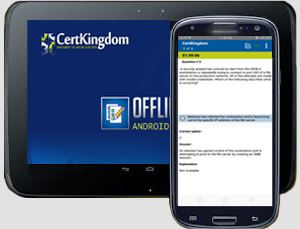
Take your learning mobile android device with all the features as desktop offline testing engine. All android devices are supported.
Supported Platforms: All Android OS EULA
Install the Android Testing Engine from google play store and download the app.ck from certkingdom website android testing engine download

Certkingdom Android Testing Engine Features
- CertKingdom Offline Android Testing Engine
- Make sure to enable Root check in Playstore
- Live Realistic practice tests
- Live Virtual test environment
- Live Practice test environment
- Mark unanswered Q&A
- Free Updates
- Save your tests results
- Re-examine the unanswered Q & A
- Make your own test scenario (settings)
- Just like the real tests: multiple choice questions
- Updated regularly, always current
