
Exam: DEA-C01

|
|||||||||||||||||||||||||||

The SnowPro DEA-C01 SnowPro Advanced Data Engineer Certification Exam is an
advanced-level certification from Snowflake that requires a passing score of 750
out of 1000. The exam has 65 questions, a 115-minute time limit, costs $375 USD,
and covers topics like data movement, performance optimization, storage, and
security. Prerequisites include being SnowPro Core Certified.
Exam details
Exam Name: SnowPro Advanced: Data Engineer Certification Exam
Exam Code: SnowPro DEA-C01
Level: Advanced
Prerequisites: SnowPro Core Certified
Registration Fee: $375 USD
Number of Questions: 65
Question Types: Multiple Choice, Multiple Select
Time Limit: 115 minutes
Passing Score: 750 (scaled score from 0 to 1000)
Delivery Options: Online Proctoring or Onsite Testing Centers
Key exam topics
Data Movement: Loading and ingesting data, building continuous data
pipelines, and designing data sharing solutions
Performance Optimization: Troubleshooting underperforming queries and
configuring solutions for optimal performance
Storage and Data Protection: Implementing data recovery, Time Travel,
micro-partitions, and cloning
Security: Managing system roles, data governance, and other Snowflake security
principles
SNOWPRO ADVANCED: DATA ENGINEER OVERVIEW
This certification will test the ability to:
• Source data from Data Lakes, APIs, and on-premises
• Transform, replicate, and share data across cloud platforms
• Design end-to-end near real-time streams
• Design scalable compute solutions for Data Engineer workloads
• Evaluate performance metrics
SNOWPRO ADVANCED: DATA ENGINEER CANDIDATE
2 or more years of hands-on experience as a Data Engineer in a production
environment.
EXAM DOMAIN BREAKDOWN
The table below lists the main content domains and their weightings.
Domain Domain Weightings
1.0 Data Movement 26%
2.0 Performance Optimization 21%
3.0 Storage and Data Protection 14%
4.0 Data Governance 14%
5.0 Data Transformation 25%
RECOMMENDED TRAINING
As preparation for this exam, we recommend a combination of hands-on experience,
instructor-led training, and the utilization of self-study assets.
Instructor-Led Course recommended for this exam:
Snowflake Data Engineer Training
Register for the Snowflake Practice Exam now:
SnowPro Practice Exam: Data Engineer
DEA-C01 Brain Dumps Exam + Online / Offline and Android Testing Engine & 4500+ other exams included
$50 - $25 (you save $25)
Buy Now
QUESTION 1
Streams cannot be created to query change data on which of the following
objects? [Select All that Apply]
A. Standard tables, including shared tables.
B. Views, including secure views
C. Directory tables
D. Query Log Tables
E. External tables
Answer: D
Explanation:
Streams supports all the listed objects except Query Log tables.
QUESTION 2
Tasks may optionally use table streams to provide a convenient way to
continuously process new or changed dat
a. A task can transform new or changed rows that a stream surfaces. Each time a
task is scheduled to
run, it can verify whether a stream contains change data for a table and either
consume the change
data or skip the current run if no change data exists. Which System Function can
be used by Data
engineer to verify whether a stream contains changed data for a table?
A. SYSTEM$STREAM_HAS_CHANGE_DATA
B. SYSTEM$STREAM_CDC_DATA
C. SYSTEM$STREAM_HAS_DATA
D. SYSTEM$STREAM_DELTA_DATA
Answer: C
Explanation:
SYSTEM$STREAM_HAS_DATA
Indicates whether a specified stream contains change data capture (CDC) records.
QUESTION 3
1. + +
2. | SYSTEM$CLUSTERING_INFORMATION('SF_DATA', '(COL1, COL3)') |
3. | |
4. | { |
5. | "cluster_by_keys" : "(COL1, COL3)", |
6. | "total_partition_count" : 1156, |
7. | "total_constant_partition_count" : 0, |
8. | "average_overlaps" : 117.5484, |
9. | "average_depth" : 64.0701, |
10. | "partition_depth_histogram" : { |
11. | "00000" : 0, |
12. | "00001" : 0, |
13. | "00002" : 3, |
14. | "00003" : 3, |
15. | "00004" : 4, |
16. | "00005" : 6, |
17. | "00006" : 3, |
18. | "00007" : 5, |
19. | "00008" : 10, |
20. | "00009" : 5, |
21. | "00010" : 7, |
22. | "00011" : 6, |
23. | "00012" : 8, |
24. | "00013" : 8, |
25. | "00014" : 9, |
26. | "00015" : 8, |
27. | "00016" : 6, |
28. | "00032" : 98, |
29. | "00064" : 269, |
30. | "00128" : 698 |
31. | } |
32. | } |
33. + +
The Above example indicates that the SF_DATA table is not well-clustered for
which of following valid reasons?
A. Zero (0) constant micro-partitions out of 1156 total micro-partitions.
B. High average of overlapping micro-partitions.
C. High average of overlap depth across micro-partitions.
D. Most of the micro-partitions are grouped at the lower-end of the histogram,
with the majority of micro-partitions having an overlap depth between 64 and
128.
E. ALL of the above
Answer: E
QUESTION 4
Mark a Data Engineer, looking to implement streams on local views & want to
use change tracking
metadata for one of its Data Loading use case. Please select the incorrect
understanding points of
Mark with respect to usage of Streams on Views?
A. For streams on views, change tracking must be enabled explicitly for the view
and un-derlying
tables to add the hidden columns to these tables.
B. The CDC records returned when querying a stream rely on a combination of the
offset stored in
the stream and the change tracking metadata stored in the table.
C. Views with GROUP BY & LIMIT Clause are supported by Snowflake.
D. As an alternative to streams, Snowflake supports querying change tracking
metadata for views
using the CHANGES clause for SELECT statements.
E. Enabling change tracking adds a pair of hidden columns to the table and
begins storing change
tracking metadata. The values in these hidden CDC data columns provide the input
for the stream
metadata columns. The columns consume a small amount of stor-age.
Answer: C
Explanation:
A stream object records data manipulation language (DML) changes made to tables,
including inserts,
updates, and deletes, as well as metadata about each change, so that actions can
be taken us -
ing the changed data. This process is referred to as change data capture (CDC).
An individual table
stream tracks the changes made to rows in a source table. A table stream (also
referred to as simply a
â€oestream†) makes a â€oechange table†available of what changed, at the row
level, between two transac -
tional points of time in a table. This allows querying and consuming a sequence
of change records in
a transactional fashion.
Streams can be created to query change data on the following objects:
*· Standard tables, including shared tables.
*· Views, including secure views
*· Directory tables
*· External tables
When created, a stream logically takes an initial snapshot of every row in the
source object (e.g. table,
external table, or the underlying tables for a view) by initializing a point in
time (called an offset)
as the current transactional version of the object. The change tracking system
utilized by the
stream then records information about the DML changes after this snapshot was
taken. Change records
provide the state of a row before and after the change. Change information
mirrors the column
structure of the tracked source object and includes additional metadata columns
that describe each
change event.
Note that a stream itself does not contain any table data. A stream only stores
an offset for the
source object and returns CDC records by leveraging the versioning history for
the source object.
When the first stream for a table is created, a pair of hidden columns are added
to the source table
and begin storing change tracking metadata. These columns consume a small amount
of storage.
The CDC records returned when querying a stream rely on a combination of the
offset stored in the
stream and the change tracking metadata stored in the table. Note that for
streams on views, change
tracking must be enabled explicitly for the view and underlying tables to add
the hidden columns to these tables.
Streams on views support both local views and views shared using Snowflake
Secure Data Sharing,
including secure views. Currently, streams cannot track changes in materialized
views.
Views with the following operations are not yet supported:
*· GROUP BY clauses
*· QUALIFY clauses
*· Subqueries not in the FROM clause
*· Correlated subqueries
*· LIMIT clauses
Change Tracking:
Change tracking must be enabled in the underlying tables.
Prior to creating a stream on a view, you must enable change tracking on the
underlying tables for
the view.
Set the CHANGE_TRACKING parameter when creating a view (using CREATE VIEW) or
later (using ALTER VIEW).
As an alternative to streams, Snowflake supports querying change tracking
metadata for tables or
views using the CHANGES clause for SELECT statements. The CHANGES clause enables
query-ing
change tracking metadata between two points in time without having to create a
stream with an
explicit transactional offset.
QUESTION 5
To advance the offset of a stream to the current table version without
consuming the change data in
a DML operation, which of the following operations can be done by Data Engineer?
[Select 2]
A. using the CREATE OR REPLACE STREAM syntax, Recreate the STREAM
B. Insert the current change data into a temporary table. In the INSERT
statement, query the stream
but include a WHERE clause that filters out all of the change data (e.g. WHERE 0
= 1).
C. A stream advances the offset only when it is used in a DML transaction, so
none of the options
works without consuming the change data of table.
D. Delete the offset using STREAM properties SYSTEM$RESET_OFFSET( <stream_id> )
Answer: A, B
Explanation:
When created, a stream logically takes an initial snapshot of every row in the
source object (e.g. table,
external table, or the underlying tables for a view) by initializing a point in
time (called an offset)
as the current transactional version of the object. The change tracking system
utilized by the
stream then records information about the DML changes after this snapshot was
taken. Change records
provide the state of a row before and after the change. Change information
mirrors the column
structure of the tracked source object and includes additional metadata columns
that describe each
change event.
Note that a stream itself does not contain any table data. A stream only stores
an offset for the
source object and returns CDC records by leveraging the versioning history for
the source object.
A new table version is created whenever a transaction that includes one or more
DML statements is
committed to the table.
In the transaction history for a table, a stream offset is located between two
table versions. Querying
a stream returns the changes caused by transactions committed after the offset
and at or before
the current time.
Multiple queries can independently consume the same change data from a stream
without changing
the offset. A stream advances the offset only when it is used in a DML
transaction. This behavior
applies to both explicit and autocommit transactions. (By default, when a DML
statement is executwww.
dumpsplanet.com
ed, an autocommit transaction is implicitly started and the transaction is
committed at the completion
of the statement. This behavior is controlled with the AUTOCOMMIT parameter.)
Querying a
stream alone does not advance its offset, even within an explicit transaction;
the stream contents
must be consumed in a DML statement.
To advance the offset of a stream to the current table version without consuming
the change data in
a DML operation, complete either of the following actions:
*· Recreate the stream (using the CREATE OR REPLACE STREAM syntax).
Insert the current change data into a temporary table. In the INSERT statement,
query the stream but
include a WHERE clause that filters out all of the change data (e.g. WHERE 0 = 1).
Buy Complete
Students Feedback / Reviews/ Discussion
Mahrous Mostafa Adel Amin 1 week, 2 days ago - Abuhib- United Arab
Emirates
Passed the exam today, Got 98 questions in total, and 2 of them weren’t from
exam topics. Rest of them was exactly the same!
upvoted 4 times
Mbongiseni Dlongolo - South Africa2 weeks, 5 days ago
Thank you so much, I passed DEA-C01 today! 41 questions out of 44 are from
Certkingdom
upvoted 2 times
Kenyon Stefanie 1 month, 1 week ago - USA State / Province = Virginia
Thank you so much, huge help! I passed DEA-C01 SnowPro today! The big majority
of questions were from here.
upvoted 2 times
Danny 1 month, 1 week ago - United States CUSTOMER_STATE_NAME: Costa Mesa =
USA
Passed the exam today, 100% points. Got 44 questions in total, and 3 of them
weren’t from exam topics. Rest of them was exactly the same!
MENESES RAUL 93% 2 week ago - USA = Texas
was from this topic! I did buy the contributor access. Thank you certkingdom!
upvoted 4 times
Zemljaric Rok 1 month, 2 weeks ago - Ljubljana Slovenia
Cleared my exam today - Over 80% questions from here, many thanks certkingdom
and everyone for the meaningful discussions.
upvoted 2 times
logged members Can Post comments / review and take part in Discussion
Certkingdom Offline Testing Engine Simulator Download

Prepare with yourself how CertKingdom Offline Exam Simulator it is designed specifically for any exam preparation. It allows you to create, edit, and take practice tests in an environment very similar to an actual exam.
Supported Platforms: Windows-7 64bit or later - EULA | How to Install?
FAQ's: Windows-8 / Windows 10 if you face any issue kinldy uninstall and reinstall the Simulator again.
Download Offline Simulator-Beta
Certkingdom Testing Engine Features
- Certkingdom Testing Engine simulates the real exam environment.
- Interactive Testing Engine Included
- Live Web App Testing Engine
- Offline Downloadable Desktop App Testing Engine
- Testing Engine App for Android
- Testing Engine App for iPhone
- Testing Engine App for iPad
- Working with the Certkingdom Testing Engine is just like taking the real tests, except we also give you the correct answers.
- More importantly, we also give you detailed explanations to ensure you fully understand how and why the answers are correct.
Certkingdom Android Testing Engine Simulator Download
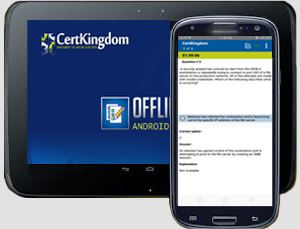
Take your learning mobile android device with all the features as desktop offline testing engine. All android devices are supported.
Supported Platforms: All Android OS EULA
Install the Android Testing Engine from google play store and download the app.ck from certkingdom website android testing engine download

Certkingdom Android Testing Engine Features
- CertKingdom Offline Android Testing Engine
- Make sure to enable Root check in Playstore
- Live Realistic practice tests
- Live Virtual test environment
- Live Practice test environment
- Mark unanswered Q&A
- Free Updates
- Save your tests results
- Re-examine the unanswered Q & A
- Make your own test scenario (settings)
- Just like the real tests: multiple choice questions
- Updated regularly, always current
