
Exam: D-PE-FN-01
|
|||||||||||||||||||||||||||

Overview
This certification validates foundational knowledge of Dell PowerEdge
servers and their associated technologies. Candidates will demonstrate
understanding of server architecture, including components, form factors, and
cooling technologies. The exam assesses knowledge of server networking
principles, protocols, connectivity options, and network security. It also
evaluates proficiency in essential server maintenance tasks, troubleshooting
techniques, and best practices for server security, including data protection
and access control. This exam is suitable for individuals seeking to demonstrate
a foundational understanding of PowerEdge servers and their role in modern IT
environments.
Certification Requirements
To successfully complete this certification, a candidate must:
1. Have a sufficient knowledgebase/skill set through hands-on product
experience and/or by consuming the recommended training.
2. Pass the Dell PowerEdge Foundations v2 Exam.
Note: These details reflect certification requirements as of date March 28 2025
The Proven Professional Program periodically updates Certifications to reflect
technical currency and relevance. Please check the Proven Professional website
regularly for the latest information.
Exam Overview
Duration 90 minutes
Products Products likely to be referred to on this exam include but are not
limited to:
PowerEdge servers
Exam Topics
Topics likely to be covered on this exam include:
Introduction to Servers (28%)
• Define the characteristics of a server
• Explain the function of various storage components commonly found in Dell
PowerEdge servers, such as Hard Disk Drives (HDDs), Solid State Drives (SSDs),
RAID controllers, BOSS and M.2, and storage enclosures.
• Describe the PowerEdge Server generations and series
• Identify a PowerEdge Server using its nomenclature
• Describe the components inside a PowerEdge Server
• Define the key storage components found in Dell PowerEdge servers, including
Hard Disk Drives (HDDs), Solid State Drives (SSDs), RAID controllers (PERC), and
backplanes.
Server Architecture and Roles (22%)
• Explain how different PowerEdge server models (e.g., rack servers, tower
servers, blade servers) are better suited for specific roles.
• Interpret data flow through a server
• Compare and contrast different storage topologies relevant to Dell PowerEdge
servers: Direct Attached Storage (DAS), Network Attached Storage (NAS), and
Storage Area Networks (SAN).
• Explain Hypervisors and virtual machines
• Describe and position a PowerEdge server in a solution - Edge (ROBO), Cloud,
Core, Use Case
• Describe and position PowerEdge server solutions for File Sharing,
High-Performance Computing (HPC), and Generative AI workloads.
Server Management (14%)
• Explain the concepts of in-band and out-of-band management in the context
of PowerEdge servers
• Compare the PowerEdge Servers management applications, utilities, and
licensing
• Differentiate between the traditional BIOS and the Unified Extensible Firmware
Interface (UEFI) boot processes on Dell PowerEdge servers
• Explain the concept of at-the-box management for Dell PowerEdge servers
• Discuss iDRAC, its features, and different versions (Basic, Express,
Enterprise, and Data Center)
• Describe Dell OpenManage System Administrator Suite (OMSA)
Server Networking and Connectivity (6%)
• Define the types of network services
• Describe the cables and connections
• Compare the on-board network on a PowerEdge Server
Maintenance (18%)
• Describe the Memory and Expansion cards
• Explain the power distribution considerations
• Explain the hardware fault indicators in PowerEdge Servers
• Describe different methods of updating firmware and drivers in PowerEdge
Servers
• Explain the cooling and thermal considerations in PowerEdge Servers (Direct
Liquid Cooling,
• Immersion Cooling, Air Cooling)"
• Describe maintenance functions, shutdowns, reboots of a PowerEdge Server
Security (12%)
• Explain the security features of PowerEdge Servers
• Explain Hardware-enforced Security in PowerEdge Servers (Silicon Root of Trust
(RoT), Secure Boot, Trusted Platform Module (TPM) 2.0, System Lockdown Mode,
Hardware Intrusion Detection, Automated BIOS and OS Recovery)
• Describe the role of iDRAC in automated security management in a PowerEdge
Server
• Discuss data protection in PowerEdge Servers (SEDs)
• Discuss features like Multifactor Authentication (MFA) and Role-Based Access
Control (RBAC) restrict access to server management tools
The percentage after each topic above reflects the approximate distribution of
the total question set across the exam.
D-PE-FN-01 Brain Dumps Exam + Online / Offline and Android Testing Engine & 4500+ other exams included
$50 - $25 (you save $25)
Buy Now
QUESTION 1
A server administrator must monitor a Dell PowerEdge server without
installing any additional software. Which management tool must they use?
A. OpenManage Enterprise
B. iDRAC
C. OMSA
D. SCG
Answer: B
QUESTION 2
A server has a PCIe 5.0 x1 lane. What is the theoretical bandwidth?
A. 3.94 GB/s
B. 1.97 GB/s
C. 7.88 GB/s
D. 0.98 GB/s
Answer: A
QUESTION 3
A film studio needs high-performance servers for video rendering tasks that
demand significant
computational power and efficiency per rack space. Which type of specialized
module server would
be most appropriate for maximizing rendering capabilities within a data center?
A. Edge-optimized modules for remote deployment and minimum footprint
B. Mainstream optimized modules balancing performance and cost for general use
C. GPU-optimized modules for enhanced graphics processing and VDI
D. Specialized modules with high compute performance and core density per rack
Answer: C
QUESTION 4
What is indicated by a blinking blue system ID LED on a PowerEdge server?
A. The system is in fail-safe mode
B. The System ID mode is active
C. The system is turned off
D. The system is experiencing a fault
Answer: B
QUESTION 5
An IT department uses Storage Resource Manager (SRM) software to monitor and
analyze their
storage infrastructure. What is the primary purpose of using Storage Resource
Manager (SRM) tools
in data center management?
A. Enhance network security and prevent unauthorized access
B. Optimize application performance and reduce server latency by adding more
nodes on the network
C. Assist data center managers with capacity planning and storage resource
management
D. Automate data backup and recovery processes
Answer: C
Buy Complete
Students Feedback / Reviews/ Discussion
Mahrous Mostafa Adel Amin 1 week, 2 days ago - Abuhib- United Arab
Emirates
Passed the exam today, Got 98 questions in total, and 2 of them weren’t from
exam topics. Rest of them was exactly the same!
upvoted 4 times
Mbongiseni Dlongolo - South Africa2 weeks, 5 days ago
Thank you so much, I passed D-PE-FN-01 today! 41 questions out of 44 are from
Certkingdom
upvoted 2 times
Kenyon Stefanie 1 month, 1 week ago - USA State / Province = Virginia
Thank you so much, huge help! I passed D-PE-FN-01 Dell today! The big majority
of questions were from here.
upvoted 2 times
Danny 1 month, 1 week ago - United States CUSTOMER_STATE_NAME: Costa Mesa =
USA
Passed the exam today, 100% points. Got 44 questions in total, and 3 of them
weren’t from exam topics. Rest of them was exactly the same!
MENESES RAUL 93% 2 week ago - USA = Texas
was from this topic! I did buy the contributor access. Thank you certkingdom!
upvoted 4 times
Zemljaric Rok 1 month, 2 weeks ago - Ljubljana Slovenia
Cleared my exam today - Over 80% questions from here, many thanks certkingdom
and everyone for the meaningful discussions.
upvoted 2 times
logged members Can Post comments / review and take part in Discussion
Certkingdom Offline Testing Engine Simulator Download

Prepare with yourself how CertKingdom Offline Exam Simulator it is designed specifically for any exam preparation. It allows you to create, edit, and take practice tests in an environment very similar to an actual exam.
Supported Platforms: Windows-7 64bit or later - EULA | How to Install?
FAQ's: Windows-8 / Windows 10 if you face any issue kinldy uninstall and reinstall the Simulator again.
Download Offline Simulator-Beta
Certkingdom Testing Engine Features
- Certkingdom Testing Engine simulates the real exam environment.
- Interactive Testing Engine Included
- Live Web App Testing Engine
- Offline Downloadable Desktop App Testing Engine
- Testing Engine App for Android
- Testing Engine App for iPhone
- Testing Engine App for iPad
- Working with the Certkingdom Testing Engine is just like taking the real tests, except we also give you the correct answers.
- More importantly, we also give you detailed explanations to ensure you fully understand how and why the answers are correct.
Certkingdom Android Testing Engine Simulator Download
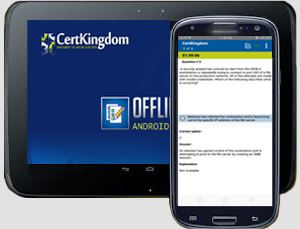
Take your learning mobile android device with all the features as desktop offline testing engine. All android devices are supported.
Supported Platforms: All Android OS EULA
Install the Android Testing Engine from google play store and download the app.ck from certkingdom website android testing engine download

Certkingdom Android Testing Engine Features
- CertKingdom Offline Android Testing Engine
- Make sure to enable Root check in Playstore
- Live Realistic practice tests
- Live Virtual test environment
- Live Practice test environment
- Mark unanswered Q&A
- Free Updates
- Save your tests results
- Re-examine the unanswered Q & A
- Make your own test scenario (settings)
- Just like the real tests: multiple choice questions
- Updated regularly, always current
