
Exam: Cybersecurity-Practitioner

|
|||||||||||||||||||||||||||

Level: Foundational
Format: Certification
Platform: All
This certification validates knowledge, understanding, and the basic skills
required to apply solutions in the areas of cybersecurity, network security,
endpoint security, cloud security, and security operations.
This certification is designed for individuals who want to validate the
knowledge, understanding, and basic skills required in the areas of
cybersecurity technologies and solutions. This is applicable to those
transitioning into a cybersecurity career or continuing the path in a Palo Alto
Networks program.
To prepare for this certification exam, we recommend that you first review the
topics and subtopics in the datasheet, and then complete the courses found in
the digital learning path as needed.
Description
The Palo Alto Networks Certified Network Security Engineer (PCNSE)
certification validates your ability to design, deploy, configure, and
troubleshoot Palo Alto Networks next-generation firewalls and security
platforms. It demonstrates advanced expertise in protecting enterprise networks
using Palo Alto’s industry-leading security solutions. This course provides a
full set of practice exams that replicate the actual PCNSE exam environment,
enabling you to test your readiness, identify weak areas, and gain the
confidence to succeed.
Our practice exams are designed according to the official PCNSE exam blueprint
and cover all essential domains, including:
Core Concepts – understanding firewall architectures, security policies, and
App-ID technology.
Network Configuration – setting up interfaces, routing, NAT, and VPN
connectivity.
Security & Threat Prevention – configuring advanced security profiles, URL
filtering, WildFire, and DoS protection.
User-ID & Authentication – managing user identification, role-based access, and
authentication methods.
Monitoring & Reporting – analyzing logs, generating reports, and leveraging
Panorama for centralized management.
Troubleshooting & Best Practices – diagnosing connectivity and policy issues,
optimizing configurations, and following security standards.
This course is ideal for network engineers, security administrators, and IT
professionals who want to validate their skills in deploying and managing Palo
Alto Networks security technologies. Prior hands-on experience with firewalls
and general networking knowledge (TCP/IP, routing, and security concepts) is
highly recommended.
By completing these practice exams, you will sharpen your technical knowledge,
master real-world firewall configurations, and be fully prepared to achieve the
PCNSE certification, advancing your career as a trusted network security engineer.
Cybersecurity-Practitioner Brain Dumps Exam + Online / Offline and Android Testing Engine & 4500+ other exams included
$50 - $25 (you save $25)
Buy Now
QUESTION 1
Which methodology does Identity Threat Detection and Response (ITDR) use?
A. Behavior analysis
B. Comparison of alerts to signatures
C. Manual inspection of user activities
D. Rule-based activity prioritization
Answer: A
Explanation:
Identity Threat Detection and Response (ITDR) leverages behavior analysis to
identify suspicious or
anomalous activities associated with user identities. This methodology involves
continuously
monitoring user authentication patterns, access events, and privilege
escalations to build a baseline
of oenormal behavior. By detecting deviations”such as unusual login locations,
timeframes, or
excessive access attempts”ITDR can flag potential identity compromises or
insider threats that
traditional signature or rule-based systems often miss. Palo Alto Networks ITDR
integrates
behavioral analytics with threat intelligence to deliver real-time alerts and
automated response
capabilities, essential in mitigating credential abuse and lateral movement
within networks. This
behavioral approach is crucial for adapting to sophisticated identity attacks
that evolve constantly.
QUESTION 2
Which technology grants enhanced visibility and threat prevention locally on
a device?
A. EDR
B. IDS
C. SIEM
D. DLP
Answer: A
Explanation:
Endpoint Detection and Response (EDR) technologies provide comprehensive
visibility and real-time
threat prevention directly on endpoint devices. EDR continuously monitors
process activities, file
executions, and system calls to detect malware, suspicious behaviors, and
zero-day threats at the
source. Palo Alto Networks Cortex XDR platform exemplifies this by correlating
endpoint telemetry
with network and cloud data to provide a holistic defense against attacks.
Operating locally on
endpoints allows EDR to prevent lateral movement and respond to threats quickly,
filling security
gaps that network-centric tools alone cannot address. This endpoint-level
insight is critical to
identifying sophisticated threats that initiate or manifest on user devices.
QUESTION 3
What are two examples of an attacker using social engineering? (Choose two.)
A. Convincing an employee that they are also an employee
B. Leveraging open-source intelligence to gather information about a high-level
executive
C. Acting as a company representative and asking for personal information not
relevant to the reason for their call
D. Compromising a website and configuring it to automatically install malicious
files onto systems that visit the page
Answer: A,C
Explanation:
Social engineering attacks manipulate human trust to gain unauthorized access or
information.
Convincing an employee that an attacker is also an employee builds rapport,
lowering defenses for
information disclosure or credential sharing. Similarly, impersonating a company
representative and
requesting unrelated personal data exploits authority bias to deceive victims.
These tactics exploit
psychological vulnerabilities rather than technical flaws and are prevalent
initial steps in multi-stage
attacks. Palo Alto Networks highlights the importance of training, multi-factor
authentication, and
behavior-based threat detection to mitigate social engineering risks
effectively.
QUESTION 4
Which two services does a managed detection and response (MDR) solution provide?
(Choose two.)
A. Improved application development
B. Incident impact analysis
C. Periodic firewall updates
D. Proactive threat hunting
Answer: B,D
Explanation:
Managed Detection and Response (MDR) services combine incident impact analysis
and proactive
threat hunting to enhance organizational security posture. Incident impact
analysis assesses the
severity, scope, and potential damage of identified threats, helping prioritize
responses. Proactive
threat hunting involves skilled analysts searching for hidden threats that
automated detection may
miss, leveraging threat intelligence and behavioral analytics. Palo Alto
Networks MDR integrates
Cortex XDR and human expertise to detect, investigate, and remediate
sophisticated threats early.
Unlike routine firewall updates or development processes, MDR is focused on
active threat discovery
and comprehensive incident management.
QUESTION 5
What role do containers play in cloud migration and application management
strategies?
A. They enable companies to use cloud-native tools and methodologies.
B. They are used for data storage in cloud environments.
C. They serve as a template manager for software applications and services.
D. They are used to orchestrate virtual machines (VMs) in cloud environments.
Answer: A
Explanation:
Containers encapsulate applications and their dependencies into lightweight,
portable units that can
run consistently across multiple environments. This abstraction supports
cloud-native development
by enabling microservices architectures, rapid deployment, and scaling within
orchestration
platforms like Kubernetes. Containers accelerate cloud migration by decoupling
applications from
infrastructure, facilitating automation, and continuous integration/continuous
deployment (CI/CD)
workflows. Palo Alto Networks addresses container security by integrating
runtime protection,
vulnerability scanning, and compliance enforcement within its Prisma Cloud
platform, ensuring safe
adoption of cloud-native tools and methodologies.
Buy Complete
Students Feedback / Reviews/ Discussion
Mahrous Mostafa Adel Amin 1 week, 2 days ago - Abuhib- United Arab
Emirates
Passed the exam today, Got 98 questions in total, and 2 of them weren’t from
exam topics. Rest of them was exactly the same!
upvoted 4 times
Mbongiseni Dlongolo - South Africa2 weeks, 5 days ago
Thank you so much, I passed Cybersecurity Practitioner today! 41 questions out of 44 are from
Certkingdom
upvoted 2 times
Kenyon Stefanie 1 month, 1 week ago - USA State / Province = Virginia
Thank you so much, huge help! I passed Cybersecurity Practitioner Palo Alto today! The big majority
of questions were from here.
upvoted 2 times
Danny 1 month, 1 week ago - United States CUSTOMER_STATE_NAME: Costa Mesa =
USA
Passed the exam today, 100% points. Got 44 questions in total, and 3 of them
weren’t from exam topics. Rest of them was exactly the same!
MENESES RAUL 93% 2 week ago - USA = Texas
was from this topic! I did buy the contributor access. Thank you certkingdom!
upvoted 4 times
Zemljaric Rok 1 month, 2 weeks ago - Ljubljana Slovenia
Cleared my exam today - Over 80% questions from here, many thanks certkingdom
and everyone for the meaningful discussions.
upvoted 2 times
logged members Can Post comments / review and take part in Discussion
Certkingdom Offline Testing Engine Simulator Download

Prepare with yourself how CertKingdom Offline Exam Simulator it is designed specifically for any exam preparation. It allows you to create, edit, and take practice tests in an environment very similar to an actual exam.
Supported Platforms: Windows-7 64bit or later - EULA | How to Install?
FAQ's: Windows-8 / Windows 10 if you face any issue kinldy uninstall and reinstall the Simulator again.
Download Offline Simulator-Beta
Certkingdom Testing Engine Features
- Certkingdom Testing Engine simulates the real exam environment.
- Interactive Testing Engine Included
- Live Web App Testing Engine
- Offline Downloadable Desktop App Testing Engine
- Testing Engine App for Android
- Testing Engine App for iPhone
- Testing Engine App for iPad
- Working with the Certkingdom Testing Engine is just like taking the real tests, except we also give you the correct answers.
- More importantly, we also give you detailed explanations to ensure you fully understand how and why the answers are correct.
Certkingdom Android Testing Engine Simulator Download
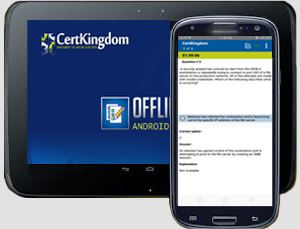
Take your learning mobile android device with all the features as desktop offline testing engine. All android devices are supported.
Supported Platforms: All Android OS EULA
Install the Android Testing Engine from google play store and download the app.ck from certkingdom website android testing engine download

Certkingdom Android Testing Engine Features
- CertKingdom Offline Android Testing Engine
- Make sure to enable Root check in Playstore
- Live Realistic practice tests
- Live Virtual test environment
- Live Practice test environment
- Mark unanswered Q&A
- Free Updates
- Save your tests results
- Re-examine the unanswered Q & A
- Make your own test scenario (settings)
- Just like the real tests: multiple choice questions
- Updated regularly, always current
