
Exam: RVT_ELEC_01101

|
|||||||||||||||||||||||||||

The RVT_ELEC_01101 exam is the official Autodesk Certified Professional in
Revit for Electrical Design certification exam. This certification validates a
candidate's skills in using Autodesk Revit for electrical engineering design.
Exam Details
Certification Name: Autodesk Certified Professional in Revit for Electrical
Design.
Purpose: The exam is designed to authenticate a professional's skill set in
electrical design using the Revit software.
Key Topics: Based on forum discussions and preparation materials, the exam
covers areas such as:
Circuiting and Load Analysis
Panel Schedules and Annotation
Lighting Analysis and System Configuration
Advanced Revit electrical workflows
Troubleshooting panel schedules and circuit data display
Format: The exam typically involves practical, performance-based questions,
likely requiring hands-on application within the Revit environment, along with
theoretical questions. It is available in various formats, including web-based
practice exams and PDF questions for preparation.
Provider: The certification is issued by Autodesk.
Registration and Dates
Specific, universally applicable exam dates are not publicly listed as the
exam is likely offered on-demand through certified testing centers.
Scheduling: Candidates must register and schedule their exam through the
official Autodesk certification program channels or an authorized testing
center.
Availability: Preparation material snippets from third-party sites suggest the
exam is active, with one mention of a release around October 31, 2025.
Preparation
Many candidates use third-party "exam dumps" and practice tests to prepare
for the exam, which focus on real-world application scenarios. The best
preparation involves a strong understanding of Revit's electrical design
features and practical, hands-on experience.
RVT_ELEC_01101 Brain Dumps Exam + Online / Offline and Android Testing Engine & 4500+ other exams included
$50 - $25 (you save $25)
Buy Now
QUESTION 1
Refer to exhibit.
To which panel Is Panel P4 circuited?
A. Panel P 1
B. Panel P 2
C. Panel P 5
D. Panel P 3
Answer: B
Explanation:
In Autodesk Revit MEP Electrical Design, the System Browser is used to analyze
and verify electrical
systems, including panelboard connections, circuit hierarchies, and connected
loads.
From the exhibit, the Properties palette shows that the selected equipment is a
Lighting and
Appliance Panelboard (208V MLO, 100A), named P4. To determine the parent panel
that feeds Panel
P4, we refer to the System Browser, which organizes the entire electrical
distribution network
hierarchically under the Electrical discipline.
In the System Browser on the right, under the Electrical category, we can
observe that Panel P4 is
nested directly under Panel P2. This organization indicates that P4 is circuited
to (or fed from) Panel P2.
According to the Revit MEP 2011 User's Guide, Chapter 4, oeElectrical
Systems”Using the System
Browser, it states:
oeThe System Browser displays electrical systems in a tree structure. Each
subpanel or device listed
beneath a main panel is connected to that panel through an electrical circuit.
When a panelboard
appears under another, it indicates the subpanel is fed from that parent panel.
This is further reinforced in Smithsonian Facilities Revit Electrical Template
Documentation (April
2021), Section 8.3 oeDocumentation Views, which describes:
oePanel schedules and browser hierarchies show the distribution sequence.
Subpanels appear
indented beneath their source panel, indicating electrical dependency and
circuit assignment.
Therefore, by interpreting both the Revit interface and Autodesk's
documentation, Panel P4 is a
subpanel connected to Panel P2, confirming that its electrical feed is assigned
from Panel P2.
Final Verified
Answer: B. Panel P2
Explanation:
Reference Sources:
Autodesk Revit MEP 2011 User's Guide, Chapter 4 ” Electrical Systems and the
System Browser
Smithsonian Facilities Revit Template User's Guide, Section 8.3 ” Electrical and
Fire Alarm
Templates: Documentation Views
QUESTION 2
Refer to exhibit.
In this linked architectural model, demolished walls are missing The electrical
designer teams from
the architect that the walls have been placed in a phase that does not exist in
the host model.
Which steps should the designer lake to associate the architectural phases to
their phases?
A. Open Manage Links > Manage Phases
B. Select the link > Edit Type > Phase Mapping
C. Select Phases > Graphic Overrides
D. Open Visibility Graphics > Revit Links > Display Settings
Answer: B
Explanation:
In Autodesk Revit, when demolished walls or other elements from a linked
architectural model are
missing in the host model, the issue typically lies in phase inconsistency
between the host and linked
models. The architectural model may include elements created or demolished in
phases that do not
exist or are mismatched in the electrical model (the host). To resolve this,
Revit allows users to map
phases between the host and linked models through the Phase Mapping tool in the
link's Type
Properties dialog.
According to the Autodesk Revit MEP Electrical Design Guide (Linked Models
Section, pp. 1282“
1287), the official procedure is:
oeYou can manually set up a correspondence between phases in the host model and
phases in the
linked model. To do this, you set up a phase map in the properties of the linked
model, and then
apply the phase map in the host model.
(Revit MEP User's Guide, Chapter 53 “ Linked Models, p. 1282)
The step-by-step process is precisely described in the Revit documentation as
follows:
To map phases in the linked model:
In the drawing area of the host model, select the linked Revit model.
Click Modify | RVT Links tab ā˛¤ Properties panel ā˛¤ Type Properties.
In the Type Properties dialog, find the Phase Mapping parameter and click Edit.
In the Phases dialog, select the appropriate mapping options for each phase, and
click OK.
Click OK to exit the Type Properties dialog.
(Revit MEP User's Guide, p. 1287)
This procedure ensures that demolished or existing architectural elements
display correctly according
to the electrical model's phase structure. Without this mapping, Revit cannot
interpret which linked
phase corresponds to the host's oeExisting or oeNew Construction phases, causing
certain
geometry”like demolished walls”to disappear from view.
Supporting Extracts from Revit for Electrical Design Study Documentation:
Linked Model Type Properties:
oeTo modify the type properties of a linked model, select the linked model in
the drawing area, and click
Modify | RVT Links tab ā˛¤ Properties panel ā˛¤ (Type Properties).
The Phase Mapping parameter allows you to set up a correspondence between phases
in the host
model and phases in the linked model.
(Revit MEP 2011 User's Guide, p. 1305)
Phases and Linked Models Concept:
oeWhen you link a Revit model that has more than one phase, phases in the host
model automatically
map to phases in the linked model. When this initial mapping occurs, Revit maps
phases by matching phase names.
You can manually set up a correspondence between phases in the host model and
phases in the
linked model using the Phase Mapping function.
(Revit MEP 2011 User's Guide, p. 1282)
Phase-Specific Room and Element Display:
oeIf phase-specific elements in a linked model do not reflect correctly, check
phase mapping for the
linked model. If automatic mapping does not give the desired result, map phases
manually between projects.
(Revit MEP 2011 User's Guide, p. 710)
Conclusion:
Therefore, to fix the issue where demolished walls are missing in a linked
architectural model, the
electrical designer must perform manual phase mapping between the architectural
model and the
host electrical model. This is done by selecting the linked file, opening its
Type Properties, and
editing the Phase Mapping parameter.
QUESTION 3
What should an electrical designer do to associate a lighting device with light
fixtures in a model?
A. Create a switch system using the light fixtures to define the system and add
the switch.
B. Create an electrical circuit including the light fixtures and switch as one
selection.
C. Create a switch system by selecting a switch and then adding lights
D. Create an electrical circuit using the light fixtures to define the system
and add the switch.
Answer: C
Explanation:
In Autodesk Revit Electrical Design, a lighting device (switch) must be
associated with lighting
fixtures through a switch system, not through electrical circuits. Switch
systems are independent of
lighting circuits and wiring, as they are intended to represent the control
relationship between a light
switch and the lighting fixtures it operates.
According to the Autodesk Revit MEP User's Guide (Chapter 17 “ Electrical
Systems, pages 475“478),
the official method is described under oeCreating a Switch System.
oeYou can assign lighting fixtures to specific switches in a project.
The switch system is independent of lighting circuits and wiring.
(Revit MEP User's Guide, p. 475)
oeTo create a switch system:
Select one or more lighting fixtures in a view, and click
Modify | Lighting Fixtures tab ā˛¤ Create Systems panel ā˛¤ Switch.
Click Switch Systems tab ā˛¤ System Tools panel ā˛¤ Edit Switch System.
Click Add to System, and select one or more lighting fixtures.
Click Select Switch, and select a switch in the drawing area.
Click Finish Editing System. **
(Revit MEP User's Guide, p. 476)
How It Works:
The switch system links a lighting device (switch) with lighting fixtures,
enabling Revit to manage
how light fixtures respond to specific switches.
Unlike electrical circuits, which define power flow and load connections to
panels, the switch system
defines control logic (which lights are turned on/off by which switch).
The designer begins by selecting the switch and then adding lights to its
system, ensuring all lights
associated with that switch are grouped correctly.
Supporting Extract from Revit Documentation:
oeYou can also create a lighting switch system by right-clicking the connector
for a lighting fixture and
clicking Create Switch System.
(Revit MEP User's Guide, p. 475)
oeAdd lighting fixtures to the switch system¦
Click Select Switch and select a switch in the drawing area.
(Revit MEP User's Guide, p. 476)
oeThe switch system is independent of lighting circuits and wiring.
(Revit MEP User's Guide, p. 475)
Conclusion:
To associate a lighting device (switch) with light fixtures in a Revit
electrical model, the designer must
create a switch system. This is done by selecting the switch, then adding the
desired lighting fixtures
to that system using the Add to System and Select Switch tools under the Switch
Systems tab.
QUESTION 4
An electrical designer needs to add a drafting view to a model from another
project. What is the method to do this?
A. Select Transfer Project Standards, select the desired project, and then
select the drafting view.
B. Select Open, select the desired project, right-click the desired drafting
view, and then copy/paste
C. Select Link Revit, browse to the desired model, and then select desired
drafting view
D. Select Insert from File, select Insert Views from File, browse to the desired
project, and then select the drafting view.
Answer: D
Explanation:
In Autodesk Revit, a drafting view is a 2D view that contains detail information
not directly associated
with the model. When an electrical designer needs to reuse a drafting view from
another project (for
example, standard details or symbols), the correct method is to use the Insert
Views from File
command under the Insert tab.
The Autodesk Revit MEP User's Guide “ Chapter 48 oeDetailing (page 1072)
describes the process as
follows:
oeInserting a Drafting View from Another Project
Click Insert tab ā˛¤ Import panel ā˛¤ Insert from File drop-down ā˛¤ Insert
Views from File.
In the Open dialog, select a project file, and click Open.
The Insert Views dialog opens, displaying all the views that are saved in that
project.
Select the desired drafting views and click OK.
(Revit MEP User's Guide, p. 1072)
This command imports the drafting view into the current Revit model while
preserving annotations,
filled regions, detail components, and text. It ensures that any standard
electrical symbols, notes, or
schematics created previously can be directly reused without rebuilding the
detail from scratch.
If any duplicate type names exist, Revit automatically uses the types and
properties from the current
project, displaying a warning if necessary.
oeRevit MEP creates a new drafting view with all the 2D components and text. If
you have duplicate
type names, the type name and properties from the current project are used.
(Revit MEP User's Guide, p. 1072)
Supporting Documentation Extracts:
oeSaving Drafting Views to an External Project
Select a drafting view in the Project Browser.
Right-click the view name, and click Save to New File.
(Revit MEP User's Guide, p. 1071)
oeThe saved project can then be used later to insert drafting views into another
Revit project using
Insert Views from File.
(Revit MEP User's Guide, p. 1072)
QUESTION 5
An electrical designer has noticed lighting fixtures present in an architectural
linked model. Which
tool should be used to place an instance of those fixtures in the current
electrical model while
maintaining the position from the architectural model?
A. Copy/Monitor
B. Coordination Review
C. Reconcile Hosting
D. Reload Latest
Answer: A
Explanation:
When lighting fixtures placed in an architectural linked model need to be
replicated in the electrical
model while maintaining their exact positions, the correct tool is Copy/Monitor.
This Revit feature allows the electrical designer to copy elements”like lighting
fixtures”from a
linked model into their project, while establishing a monitoring relationship
between the original
(architectural) and copied (electrical) instances.
From the Autodesk Revit MEP User's Guide “ Chapter 55 oeMulti-Discipline
Coordination (pages
1349“1357):
oeUse the Copy/Monitor tool to copy MEP fixtures from an architectural model
into an MEP project,
and monitor them for changes.
(Revit MEP User's Guide, p. 1350)
oeTo copy fixtures from a linked model:
Click Collaborate tab ā˛¤ Coordinate panel ā˛¤ Copy/Monitor ā˛¤ Select Link.
Select the linked architectural model in the drawing area.
Click Copy and select the lighting fixtures to copy.
Click Finish.
Revit MEP copies the fixtures to the current project and establishes monitoring
relationships. *
(Revit MEP User's Guide, p. 1356)
Behavior and Benefits:
The copied lighting fixtures maintain the same location, orientation, and type
mapping as in the
linked model.
Any changes (move, delete, or modify) made by the architect in the linked model
will trigger a
coordination review in the electrical model.
This ensures accurate positioning and easy coordination between disciplines.
oeWhen you select a copied fixture in the current project, the monitor icon
displays next to the fixture,
indicating that it has a relationship with the original fixture in the linked
model.
(Revit MEP User's Guide, p. 1357)
oeIf copied fixtures are moved, changed, or deleted in the linked model, Revit
MEP notifies the
engineers of the changes during Coordination Review.
(Revit MEP User's Guide, p. 1357)
Buy Complete
Certainly, here's a rewritten version of your text:
Packiam Vijendran 1 months ago - Malaysia
Passed the exam yesterday, 95% of the question were from this site. Note: Pay
more attention to all the community discussions on each question, instead of the
answers provided by the examtopics and I strongly suggest to get the contributor
access.
upvoted 4 times
Javier Cardaba Enjuto 2 months, 1 week ago - Spain
Excellent pre-exam session tool
upvoted 2 times
Palanisamy Arulmohan 1 months, 1 week ago - USA
I passed today, 94 questions asked and 99% of them were in this dump.
3 labs: BGP (as-override), HSRP, OSPF (without network statement)
upvoted 4 times
peppinauz 3 months, 2 weeks ago
I pass my exam, dump is valid about 90-95%. review the community answers!!
upvoted 6 times
Oberoi Ankit3 months, 3 weeks ago - USA Texas
Passed exam today dump still accurate. almost all the questions are here, some
are overcomplicated or incomplete on the site,
upvoted 4 times
logged members Can Post comments / review and take part in Discussion
Certkingdom Offline Testing Engine Simulator Download

Prepare with yourself how CertKingdom Offline Exam Simulator it is designed specifically for any exam preparation. It allows you to create, edit, and take practice tests in an environment very similar to an actual exam.
Supported Platforms: Windows-7 64bit or later - EULA | How to Install?
FAQ's: Windows-8 / Windows 10 if you face any issue kinldy uninstall and reinstall the Simulator again.
Download Offline Simulator-Beta
Certkingdom Testing Engine Features
- Certkingdom Testing Engine simulates the real exam environment.
- Interactive Testing Engine Included
- Live Web App Testing Engine
- Offline Downloadable Desktop App Testing Engine
- Testing Engine App for Android
- Testing Engine App for iPhone
- Testing Engine App for iPad
- Working with the Certkingdom Testing Engine is just like taking the real tests, except we also give you the correct answers.
- More importantly, we also give you detailed explanations to ensure you fully understand how and why the answers are correct.
Certkingdom Android Testing Engine Simulator Download
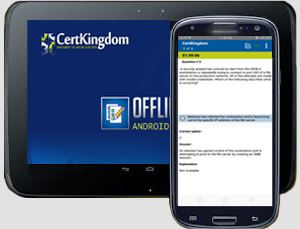
Take your learning mobile android device with all the features as desktop offline testing engine. All android devices are supported.
Supported Platforms: All Android OS EULA
Install the Android Testing Engine from google play store and download the app.ck from certkingdom website android testing engine download

Certkingdom Android Testing Engine Features
- CertKingdom Offline Android Testing Engine
- Make sure to enable Root check in Playstore
- Live Realistic practice tests
- Live Virtual test environment
- Live Practice test environment
- Mark unanswered Q&A
- Free Updates
- Save your tests results
- Re-examine the unanswered Q & A
- Make your own test scenario (settings)
- Just like the real tests: multiple choice questions
- Updated regularly, always current
